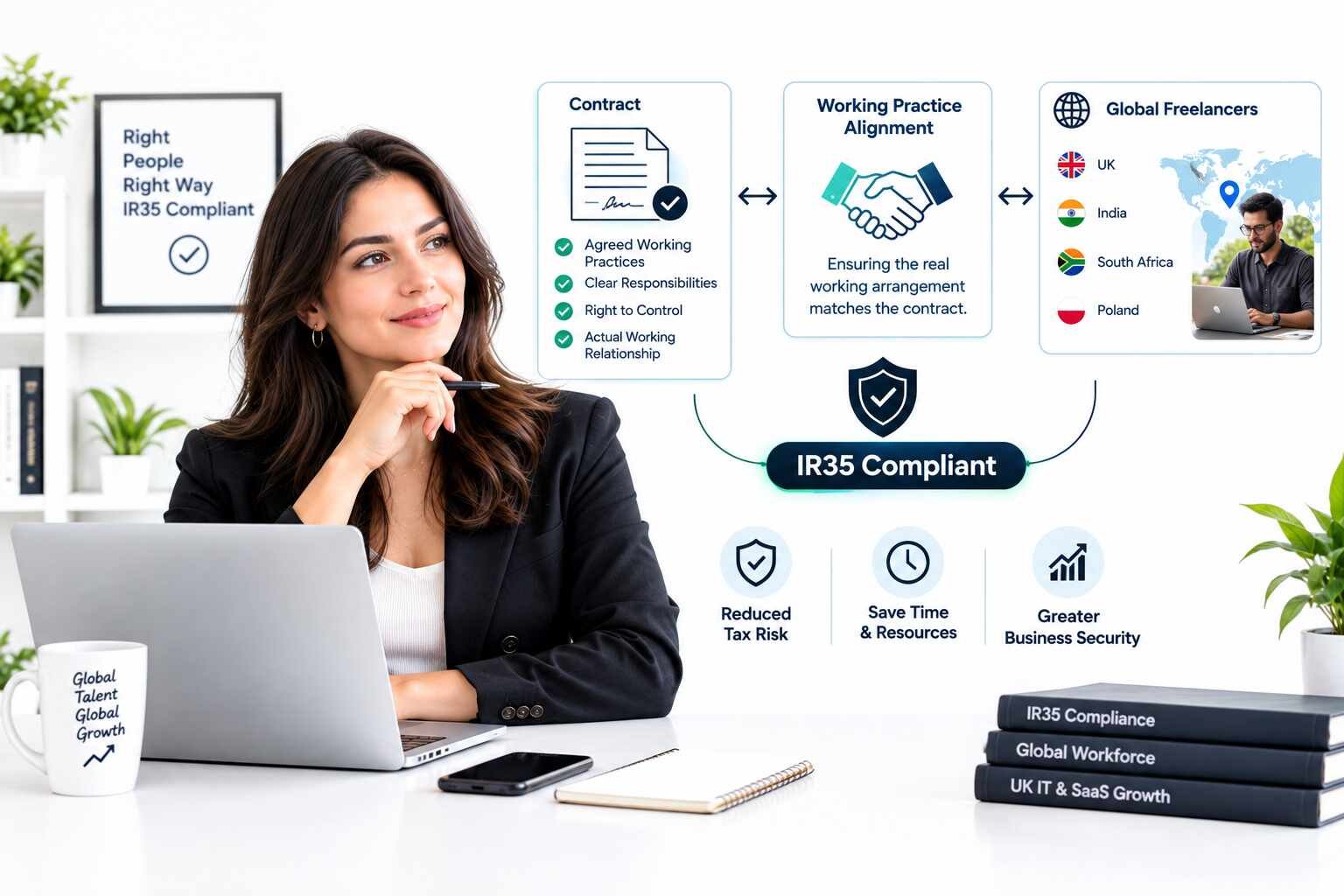
Working Practice Alignment: Keeping IR35 Contractor Reality Consistent With the Contract.
Working Practice Alignment
For UK IT, SaaS and technology businesses, an IR35 assessment is not a one-time paperwork exercise ,it required working practice alignment with various factors.
A contractor’s written agreement may describe an independent relationship, but HMRC guidance makes clear that an engagement is assessed by looking at both its contractual terms and actual working practices. If the reality of the engagement changes, the business may need to review the position.
That makes working practice alignment an important part of ongoing contractor compliance.
For CFOs, finance directors, HR leaders and procurement teams, the objective is straightforward:
Make sure the way the contractor actually works remains consistent with the assumptions behind the original status determination.
This is particularly important for technology businesses where project requirements, management structures and delivery models can change quickly.
Why Contract Terms Alone Are Not Enough
An agreement might state that a contractor:
- has a genuine right of substitution;
- controls how the work is delivered;
- carries financial risk;
- can work for other clients;
- is engaged for specific deliverables; and
- is not entitled to an ongoing obligation of work.
The practical lesson: don’t just monitor the contract. Monitor the engagement.
1. Monitor Genuine Substitution Rights:
Substitution is often an important consideration when assessing contractor status.
However, a substitution clause should reflect a genuine commercial right, rather than existing only on paper.
HMRC specifically states that a substitution obligation or right needs to be genuine before it can carry weight in determining employment status.
For a UK SaaS company, useful questions include:
- Can the contractor genuinely provide a suitably qualified substitute?
- Has the business prevented substitution in practice?
- Does the contract require the contractor to personally perform all services?
- If substitution is proposed, is it handled according to the agreed process?
- Has the nature of the project changed so that personal service has effectively become mandatory?
This does not mean a contractor must constantly use substitutes.
The issue is whether the contractual right reflects the genuine commercial arrangement.
2. Watch Financial Risk:
Financial risk is another factor HMRC considers when assessing employment status.
A genuinely independent business may bear some commercial risk associated with delivering its services and may have an opportunity to increase profitability through efficient management or delivery.
HMRC identifies financial risk, responsibility for investment and management, and opportunity to profit as relevant factors in determining whether someone is operating a business on their own account.
For technology businesses, monitoring can include questions such as:
- Is payment linked to defined deliverables or simply time worked?
- Does the contractor have responsibility for correcting defective work?
- Who bears the cost of rectification?
- Does the contractor provide their own equipment or resources where appropriate?
- Can the contractor make a genuine profit or loss from how the engagement is managed?
No single factor determines status. The important point is whether the real commercial relationship continues to match the original assessment.
3. Review Mutuality of Obligation:
Mutuality of obligation can also form part of the employment-status analysis.
HMRC explains the basic contractual concept as an obligation on the engager to provide remuneration and an obligation on the worker to provide their work or skill.
For contractor management, businesses should therefore be alert to arrangements that gradually begin to resemble ongoing employment.
For example:
Original arrangement:
A contractor is engaged for a defined development project with specific deliverables.
Working practice changes:
The contractor becomes a permanent member of a product team, receives continuous work, follows an employee-like schedule and is expected to remain available for ongoing assignments.
That change should trigger a review rather than being ignored because the original contract has not changed.
4. Monitor Control in Day-to-Day Operations:
Control is another important part of the employment-status picture.
HMRC considers control over what, how, when and where work is performed. The existence of a right to control can be significant even where that control is not exercised constantly.
This can be particularly relevant to UK technology companies.
A specialist software engineer may naturally receive technical requirements from the client. That alone does not answer the employment-status question.
The more useful question is whether the business has acquired a level of control over the contractor’s working methods, schedule and delivery that is inconsistent with the assumptions behind the original assessment.
Regular project-management practices should therefore be distinguished from arrangements that materially change the contractor relationship.
Build a Working Practice Monitoring Framework.
A practical compliance framework can be relatively simple:
Contract → Assess → Onboard → Monitor → Review → Document
At onboarding, record the assumptions behind the status determination.
During the engagement, monitor material changes.
When something changes, ask:
Has this change altered the facts on which the original status decision was based?
Potential review triggers could include:
- Major changes to responsibilities
- A new reporting structure
- Contractor becoming embedded within a permanent team
- Changes to working hours or location requirements
- Removal or restriction of substitution rights
- Changes to payment arrangements
- Significant changes to financial risk
- Extension or renewal of the engagement
- Contractor taking on an ongoing operational role
- Changes in contractual terms
HMRC specifically says that where working practices change or a new contract is negotiated, the client should re-check whether the off-payroll rules still apply.
Create an Audit Trail of Changes:
Monitoring only helps if the business can demonstrate what it monitored.
For each contractor, consider maintaining a central record containing:
- Original contract
- Original status assessment
- SDS and reasons
- Key working-practice assumptions
- Review dates
- Material changes
- Management or project-owner confirmations
- Updated assessment where required
- Revised SDS where applicable
- Relevant correspondence and supporting evidence
This creates a clear chronology:
What was agreed → What actually happened → What changed → What was reviewed properly→ What decision is followed.
Automating Working Practice Alignment:
A contractor management platform can help centralise information and create workflow triggers around:
- Contract renewals
- Status reviews
- SDS documentation
- Contractor questionnaires
- Engagement changes
- Approval workflows
- Compliance records
- Payment processes
The objective is not to automate a legal conclusion.
Instead, technology can help ensure that changes in the real-world engagement do not disappear inside email threads, project-management tools or spreadsheets.
This distinction matters because HMRC states that reasonable care remains the client’s responsibility when making an off-payroll determination.
Working Practice Alignment Checklist
Before continuing a contractor engagement, ask:
| Area | Question to Review |
|---|---|
| Substitution | Is the contractual substitution right genuine and consistent with actual practice? |
| Financial risk | Does the contractor continue to bear the commercial risks identified in the assessment? |
| Mutuality | Has the relationship developed into an ongoing expectation of work and personal service? |
| Control | Has the business gained greater control over what, how, when or where the contractor works? |
| Integration | Has the contractor become materially embedded within the organisation? |
| Payment | Has the basis of payment changed significantly? |
| Contract | Have the contractual terms or scope changed? |
| Evidence | Can the business demonstrate what the engagement actually looked like? |
This is not a statutory checklist and no individual answer determines IR35 status. HMRC emphasises that employment status depends on the overall facts of the engagement.
Why CFOs Should Care About Working Practice Alignment
IR35 exposure can develop gradually.
A contractor may initially fit the assumptions behind an outside-IR35 assessment, but the commercial relationship can evolve as the company grows.
The risk is not necessarily a dramatic event.
It can be a series of small operational decisions.
Individually, these changes may not determine employment status. Collectively, however, they may change the overall picture of the engagement.
That is why contractor compliance should extend beyond the legal team and involve HR, finance, procurement, hiring managers and project leaders.
The CFO Takeaway:
For UK IT and SaaS businesses, working practice alignment means making sure the contractor relationship described in the compliance documentation continues to resemble the relationship operating in reality.
A robust process should:
Assess → Contract → Document → Monitor → Identify Changes → Reassess → Record
The goal is not to manufacture a particular IR35 outcome.
The goal is to ensure that the business’s status determination remains based on accurate, current facts.
For growing technology companies, platforms that combine contractor management, compliance workflows, status documentation and payment processes can help create a more controlled operating model.
Ready to Strengthen Contractor Compliance?
Your UK technology business manages global freelance contractors through personal service companies, consider platforms that can help centralize contractor onboarding, compliance documentation, IR35 workflows and ongoing contractor administration.
Explore Deel for Contractor & IR35 Management →
Explore Multiplier for Contractor Compliance →
Affiliate Disclosure:
This article may contain affiliate links.
Compliance Note:
This article provides general business information and is not legal or tax advice. IR35 and employment-status decisions depend on the facts of each engagement. UK businesses should obtain appropriate professional advice where the correct status or tax treatment is uncertain.
FAQs:
Why do working practices matter for IR35?
Working practices matter because UK off-payroll status assessments consider both the contractual terms and the actual working arrangements. HMRC identifies factors including control, personal service, substitution, financial risk, mutuality of obligation and integration when assessing employment status. If the working practices materially change, the client should review whether the existing determination remains appropriate.
Why should UK businesses monitor substitution rights?
A substitution clause can be relevant to employment status, but HMRC says the right or obligation must be genuine to carry weight. A contractual substitution provision that does not reflect the actual relationship may therefore provide limited support for the intended status assessment.
What is mutuality of obligation in IR35?
HMRC describes the basic contractual requirements as an obligation on the engager to provide remuneration and an obligation on the worker to provide their work or skill. Mutuality is one part of the wider employment-status analysis and does not determine status by itself.
Does changing a contractor’s working practices require an IR35 review?
It can. HMRC states that where the working practices of an engagement change, or a new contract is negotiated, the client should check whether the off-payroll rules still apply.