Automated Status Determination for IT & SaaS Businesses: Smarter IR35 Compliance
Automated Status Determination: A Strategic IR35 Solution for UK Tech Companies
UK IT, SaaS and technology businesses depend on specialist contractors to scale engineering teams, accelerate product development and deliver complex digital projects. From software engineers and DevOps specialists to cybersecurity consultants and data architects, contractors provide valuable flexibility.
However, rapid growth and changing project requirements can make IR35 compliance increasingly challenging.
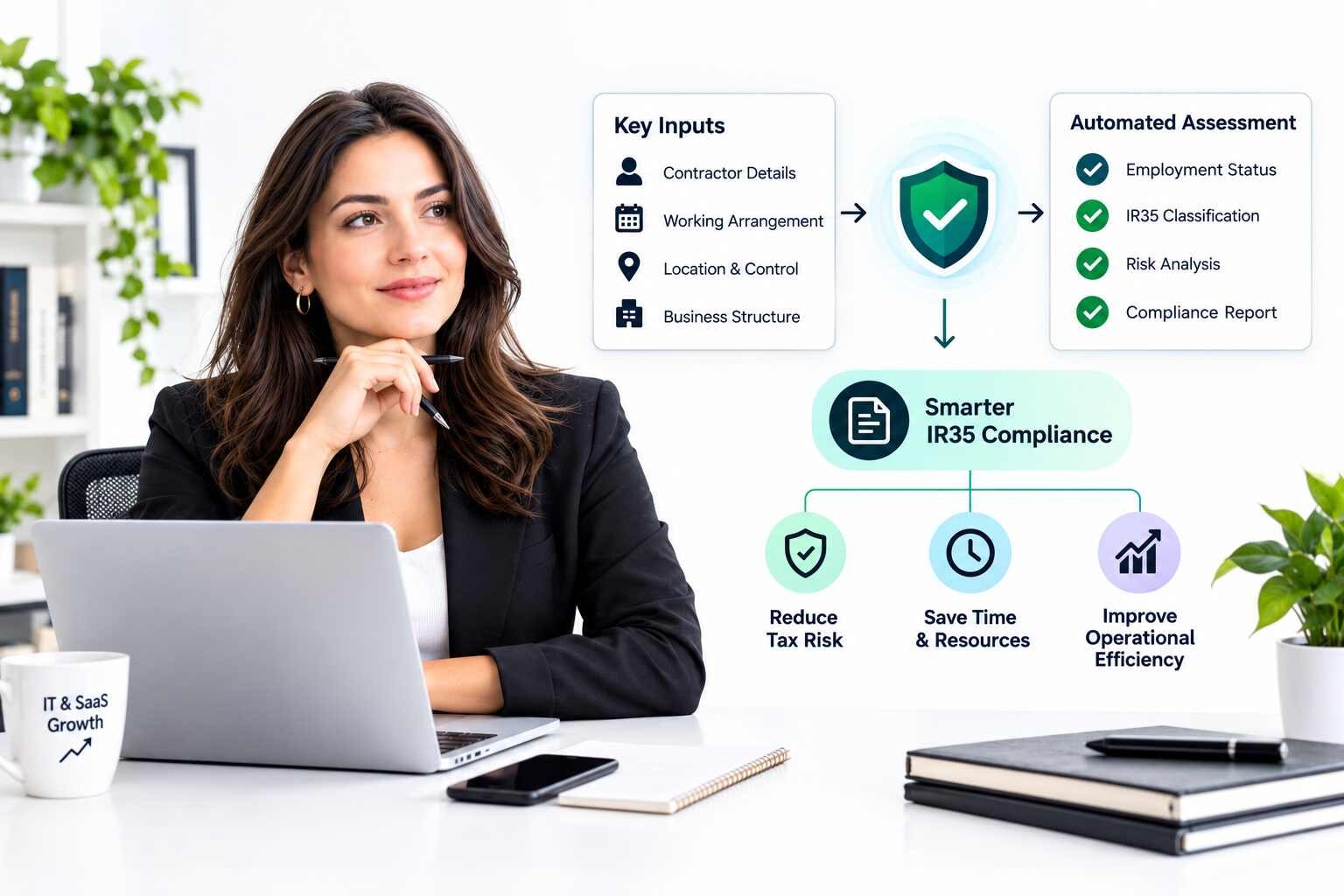
Automated Status Determination helps technology businesses establish structured contractor assessment workflows, support ongoing reviews and maintain better Status Determination Statement (SDS) records.
For CEOs, CFOs and technology leaders, the objective is to scale contractor operations while improving compliance oversight and controlling potential PAYE, National Insurance Contributions (NICs) and misclassification risks.
Why IR35 Compliance Matters for IT & SaaS Companies
Technology businesses often operate with flexible, project-based teams. A software engineer may initially join for a defined development project, but their responsibilities, reporting arrangements or working practices can change over time.
These changes may affect the employment status assessment.
Common contractor roles in UK tech businesses include:
- Software engineers and developers.
- Cloud architects and DevOps consultants.
- Cybersecurity specialists.
- Data scientists and AI consultants.
- Product managers.
- QA and automation engineers.
- IT infrastructure specialists.
Under the off-payroll working rules, applicable medium and large private-sector organisations must assess contractor status and provide a Status Determination Statement. Where the rules apply, the responsible fee-payer must operate PAYE and account for relevant National Insurance obligations.
A structured assessment process helps businesses manage these responsibilities more consistently.
The Limitations of Static CEST Assessments
HMRC’s Check Employment Status for Tax (CEST) tool is one resource businesses can use to assess employment status. However, a single assessment completed at the start of a contract may not reflect later changes to the engagement.
For example, a SaaS company may hire a contractor to develop a new application feature. Initially, the contractor works independently with defined deliverables. Several months later, the contractor becomes embedded within the internal engineering squad, attends daily stand-ups and follows changing delivery instructions.
The practical working relationship may now differ from the original assessment.
The key risk is not simply using a static assessment. It is failing to review whether the original decision still reflects the actual engagement.
How Automated Status Determination Supports Tech Businesses
1. Continuous Contractor Assessment Reviews
Automated compliance workflows can help IT and SaaS companies schedule periodic reviews of contractor engagements.
This is particularly useful where:
- Engineering projects run for extended periods.
- Contractors move between development teams.
- Product priorities change.
- Reporting structures evolve.
- Contractors take on new responsibilities.
Regular reviews can help identify when a fresh status assessment may be appropriate.
2. Structured SDS Generation
A Status Determination Statement should communicate the employment status decision and the reasons for reaching it.
Technology-supported workflows may help organisations collect relevant information, organise assessment records and generate documentation consistently.
For CFOs and compliance teams, this can improve visibility across large contractor populations.
Automation supports documentation; it does not guarantee that an SDS is accurate or legally defensible. The client must ensure the assessment is reasonable, evidence-based and compliant with applicable requirements.
3. Improved Contractor Governance
Growing SaaS companies may manage hundreds of contractors across engineering, product, IT operations and security.
Manual spreadsheets and disconnected assessment documents can make it harder to maintain a consistent compliance process.
An automated platform may help centralise:
- Contractor engagement information.
- Assessment dates.
- Status decisions.
- Review history.
- Supporting evidence.
- SDS documentation.
This can support stronger internal governance and improve coordination between finance, HR, procurement and engineering leadership.
Can Automated Status Determination Prove a Genuine Contractor?
Automated status determination can help organisations assess and document contractor characteristics, but software cannot independently prove that a contractor is genuinely self-employed or guarantee an outside-IR35 outcome.
HMRC considers the actual circumstances of the engagement, including contractual terms and working practices.
For IT and SaaS businesses, relevant considerations may include:
- Who controls the work and how it is delivered.
- Whether the contractor can provide a substitute.
- The degree of independence in performing services.
- Mutuality of obligations.
- The practical relationship between the contractor and client.
The assessment must reflect the real engagement—not simply the preferred tax treatment.
Deel vs Multiplier: Automated Contractor Compliance for UK Tech Companies
Deel and Multiplier offer global contractor management solutions that technology companies may explore. The exact availability of automated status determination, SDS generation and contractual protection should be confirmed with each provider.
| Feature | Deel | Multiplier |
|---|---|---|
| IT contractor management | Supports global contractor onboarding and payments | Supports global contractor onboarding and management |
| Status assessment | Confirm available UK classification and compliance workflows | Confirm available UK classification and compliance workflows |
| SDS generation | Verify UK-specific SDS functionality | Verify UK-specific SDS functionality |
| Ongoing reviews | Check monitoring and reassessment options | Check monitoring and reassessment options |
| Tech business fit | Useful to evaluate for scaling international teams | Useful to evaluate for scaling international teams |
| Key consideration | Review IR35 scope, liability and exclusions | Review IR35 scope, liability and exclusions |
Why CFOs and CEOs Should Prioritise Automated IR35 Workflows
For technology businesses, contractor compliance directly connects with financial planning, workforce scaling and operational risk management.
A structured automated workflow may help leadership teams:
Reduce Manual Compliance Administration
Finance and HR teams can spend less time managing fragmented contractor records and repetitive assessment workflows.
Improve Financial Visibility
Better documentation and clearer responsibility allocation can support financial planning around potential payroll tax exposure.
Support Scalable Growth
As engineering and product teams expand, consistent contractor onboarding and review processes become increasingly valuable.
Strengthen Governance
Centralised assessment records can support internal reviews, audit preparation and coordination across business functions.
Automation is most valuable when it improves the quality and consistency of the underlying compliance process.
What Should a UK SaaS Company Check Before Choosing a Platform?
Before adopting an automated contractor compliance solution, technology leaders should assess:
- UK IR35 coverage: Does the platform support the organisation’s specific off-payroll working requirements?
- Assessment methodology: How are contractor status decisions reached and documented?
- SDS functionality: Can the platform generate and retain appropriate Status Determination Statements?
- Continuous monitoring: Does it support periodic reviews when working arrangements change?
- Liability allocation: Which party assumes responsibility for PAYE, NICs, interest and penalties under the agreement?
- Integration: Can the platform fit existing HR, finance and procurement workflows?
- Scalability: Is it suitable for the company’s growing contractor and international workforce?
The right solution should align with both the business’s operational needs and its compliance responsibilities.
Explore Deel and Multiplier for Your Tech Business:
If your IT or SaaS company is expanding its contractor workforce, exploring contractor management platforms can be a practical step towards more structured compliance operations.
Deel and Multiplier provide global workforce solutions that businesses can review against their contractor engagement requirements.
Before signing up, compare the available features, pricing, UK-specific IR35 support and contractual protection.
Explore the platforms through our affiliate links:
- Deel: Review contractor management and compliance solutions.
- Multiplier: Explore global contractor management and workforce services.
Select a platform based on documented capabilities and the specific needs of your technology business.
Frequently Asked Questions: FAQs
What is automated status determination in IT?
Automated status determination is a technology-supported process that helps IT companies assess contractor employment status, organise compliance records and support SDS generation.
Why is continuous IR35 monitoring important for SaaS companies?
SaaS projects and engineering roles can evolve quickly. Changes in responsibilities, control and working arrangements may require businesses to reconsider an existing status determination.
Can automation guarantee an outside-IR35 decision?
No. Employment status depends on the actual facts of the engagement. Automated tools cannot guarantee a particular tax classification or eliminate all HMRC liability.
Is automated SDS generation useful for technology companies?
It can help businesses organise assessment information and produce consistent documentation. The client remains responsible for ensuring the determination and reasons meet the applicable requirements.
Can Deel and Multiplier support contractor compliance?
Both platforms offer contractor management solutions. Technology businesses should verify the current UK-specific features, assessment capabilities and contractual terms directly with each provider.
Conclusion:
Automated Status Determination offers UK IT and SaaS businesses a way to improve contractor assessment workflows, strengthen documentation and support scalable IR35 compliance operations.
For CEOs and CFOs, the opportunity is to combine workforce flexibility with stronger financial oversight and consistent governance.
However, automation should support—not replace—accurate employment status assessments, reasonable care and ongoing review of working arrangements.
Explore Deel and Multiplier to compare contractor management solutions for your growing technology business.
Affiliate Disclosure: This website may earn a commission from qualifying purchases or sign-ups through affiliate links. This does not increase your cost. This article is for general information only and does not constitute tax or legal advice.