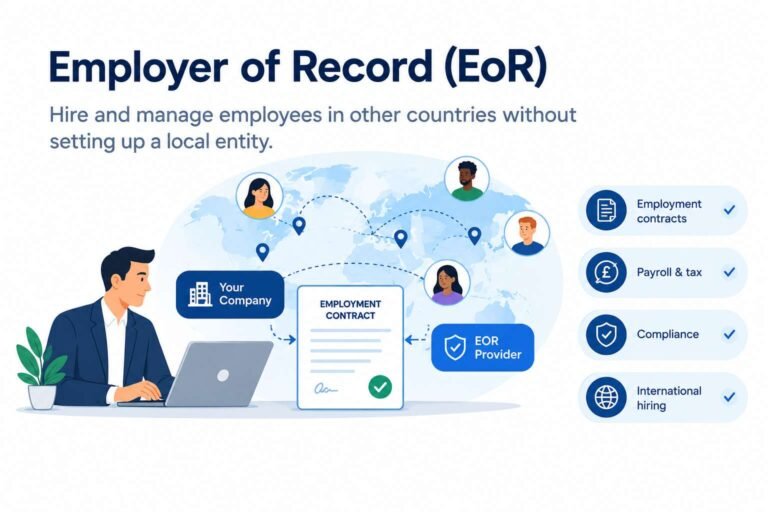
Cross-Border Tax & Compliance Parity: How UK Tech Businesses Can Safely Contract Non-UK Freelancers.
Cross-Border Tax & Compliance Parity:
For UK SaaS, IT and technology businesses, hiring specialist talent overseas can be an efficient way to access skills without building every capability in-house. But a freelancer agreement alone does not automatically make an international engagement legally or tax compliant.
The real challenge is cross-border tax and compliance parity: making sure the contractor relationship, contract, tax documentation and payment process reflect the rules that apply in both the UK and the freelancer’s jurisdiction.
Getting this wrong can create exposure to worker reclassification, unexpected tax obligations, penalties or employment-law disputes.
The good news is that a structured onboarding process, supported by the right global workforce platform, can make international contractor management considerably easier.
What UK Businesses Need to Check Before Hiring Overseas Freelancers.
1. Confirm the Worker Is Genuinely a Contractor:
Calling someone a “freelancer” in a contract does not, by itself, determine their legal status.
UK guidance says employment status depends on the actual working relationship, rather than simply the wording of the contract.
For a UK technology business, consider questions such as:
- Does the individual control how and when the work is performed?
- Can they provide a substitute or subcontract the work?
- Are they operating an independent business?
- Do they invoice for completed work?
- Are they taking commercial risk?
- Does the relationship resemble employment in practice?
This becomes particularly important when a freelancer works almost exclusively for one company over an extended period.
For certain UK arrangements involving intermediaries, the IR35/off-payroll working rules may also need to be considered.
2. Understand the Freelancer’s Local Employment Legislation:
The fact that a worker is overseas does not mean local employment legislation can be ignored.
Different countries use different tests when determining whether someone is genuinely self-employed or should receive employment protections.
A contract should therefore be more than a UK template with the freelancer’s address changed.
An international contractor agreement should consider relevant local requirements, including:
- Contractor classification
- Payment and invoicing requirements
- Tax documentation
- Intellectual property ownership
- Confidentiality
- Termination provisions
- Data protection
- Local mandatory requirements
The working relationship should also be reviewed periodically because circumstances can change.
3. Don’t Overlook Cross-Border Tax and Withholding:
International payments can create tax questions that are easy for a growing finance team to overlook.
The treatment can depend on factors including:
- Where the contractor performs the work
- Where the business is established
- The nature of the services
- Whether the contractor operates through a company
- Local withholding requirements
- Applicable tax treaties
- Other local reporting or tax obligations
There is no universal “pay the invoice and forget about it” rule.
For CFOs and finance leaders, the objective should be to create a documented process covering classification, tax documentation, approvals, payments and record keeping before the first international invoice arrives.
A Practical Compliance Workflow for UK SaaS Companies:
A scalable process can follow this simple model:
Classify → Contract → Collect Documents → Check Tax Requirements → Approve → Pay → Monitor
This creates a clearer audit trail and reduces dependence on spreadsheets, emails and ad-hoc compliance checks.
For a business hiring one overseas freelancer, a manual process may be manageable. Once a technology company has contractors across several countries, however, managing different contracts, payment methods, tax requirements and compliance checks can become considerably more complex.
This is where specialist Contractor of Record (COR) and global contractor management platforms can be useful.
Deel vs Multiplier for International Contractor Management:
Two platforms UK technology businesses may wish to investigate are Deel and Multiplier.
Both offer tools designed to help businesses manage international contractors, including contractor agreements, compliance processes and cross-border payments.
| Feature | Deel | Multiplier |
|---|---|---|
| International contractor management | Yes | Yes |
| Localised contractor contracts | Yes | Yes |
| Contractor classification support | Yes | Yes |
| Global contractor payments | Yes | Yes |
| Contractor compliance tools | Yes | Yes |
| Contractor of Record model | Available | Available |
| International coverage | 200+ countries/jurisdictions advertised | 150+ countries advertised |
| Suitable for | Businesses seeking a broad global workforce platform | Businesses seeking international contractor and compliance workflows |
Deel states that its contractor solution includes local contracts, classification assessments, compliance monitoring and global payments.
Multiplier describes its Contractor of Record service as covering worker classification, locally compliant agreements, invoices, payments and ongoing compliance.
Features, country coverage and pricing can change, so businesses should check the current offering and the specific jurisdiction before onboarding a contractor.
The CFO Takeaway: Build Compliance Into the Hiring Process
For a growing UK SaaS or IT company, international contractors should be treated as a compliance workflow, rather than simply another supplier payment.
A robust process should answer five questions:
- Who is the worker legally?
- Which country’s rules apply?
- What documentation is required?
- Are there tax or withholding obligations to address?
- How will the company maintain an audit trail?
Platforms such as Deel and Multiplier can help centralise these processes instead of leaving finance, HR and legal teams to manage everything manually.
For businesses expanding internationally, consistent contractor onboarding can help create a more controlled approach to global hiring and payments.
Ready to Explore International Contractor Compliance?
If your UK technology business is planning to hire developers, designers, marketers, consultants or other specialists overseas, compare the current contractor solutions available from Deel and Multiplier before committing to a manual process.
Explore Deel for Global Contractor Management →
Explore Multiplier for Global Contractor Management →
Affiliate Disclosure:
This article may contain affiliate links. If you use a link and subsequently purchase a qualifying service, About Accounting UK may receive a commission at no additional cost to you. This does not change the editorial information provided in this article.
Compliance Disclosure:
This article provides general business information and is not legal or tax advice. International contractor rules vary by jurisdiction and individual circumstances. UK businesses should obtain appropriate professional advice where worker classification, tax withholding or local employment-law exposure is uncertain.
How can a UK company safely hire a non-UK freelancer?
A UK company should assess the worker’s actual employment status, check the freelancer’s local contractor and tax requirements, review any UK tax or off-payroll implications, use an appropriate jurisdiction-specific contract, collect required tax documentation and maintain an auditable payment record. Global contractor platforms such as Deel and Multiplier can centralise several of these processes, but the specific legal and tax position should be checked for the countries involved.