Indemnified Fee-Payer Operations: Protecting UK Tech Businesses When Managing Contractors.
Indemnified Fee-Payer Operations.
For UK IT, SaaS and technology businesses, contractor growth can create a complex layer of IR35, PAYE, National Insurance and fee-payer responsibilities.
HMRC’s off-payroll working rules place specific responsibilities on the deemed employer or fee-payer where the rules apply. The fee-payer can be responsible for deducting Income Tax and employee National Insurance and paying employer National Insurance and Apprenticeship Levy where applicable.
A Contractor of Record (COR) model can provide a structured way to place contractor administration and fee-payer operations with a specialist global infrastructure provider.
For a UK scale-up, the commercial objective is clear:
Keep contractor operations scalable while creating a defined compliance and liability framework around the fee-payer function.
What Is a Fee-Payer Under IR35?
Under the off-payroll working rules, the fee-payer is generally the organisation immediately above the worker’s intermediary in the relevant labour supply chain.
Where the conditions are met, the fee-payer operates the deemed payment process and accounts for the applicable employment taxes and National Insurance.
For a growing SaaS company, this can introduce additional operational requirements across:
- PAYE administration
- National Insurance
- Contractor payments
- Status Determination Statements
- Contractor records
- Payment reporting
- Tax documentation
- Compliance evidence
- Disagreement procedures
A specialist COR structure can centralise many of these activities.
Why UK Scale-Ups Are Exploring Contractor of Record
International contractor programmes often involve several moving parts.
A UK technology company may have:
- Developers in Eastern Europe
- Designers in Asia
- Cybersecurity specialists in North America
- Product consultants in the Middle East
- Data specialists across multiple jurisdictions
Each location can introduce different contractor classification and payment requirements.
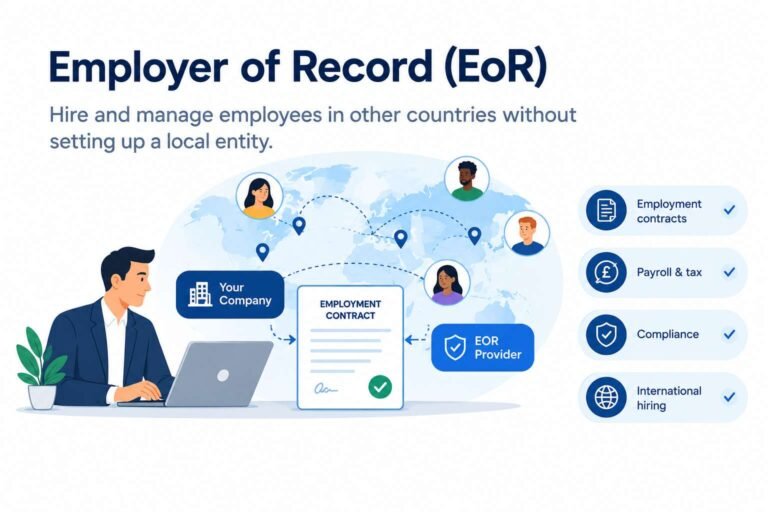
A COR provider can become the operational infrastructure between the UK business and the contractor.
UK Business → COR Provider → Contractor
The provider can manage the contractor relationship, localised documentation, classification processes, invoicing and payments according to its service model.
The Value of an Indemnified Fee-Payer Structure
A COR arrangement can provide an additional contractual layer around contractor compliance.
The exact protection depends on the provider’s agreement, eligibility rules, client obligations and indemnity wording.
For example, Deel states that its Contractor of Record service takes on contractor liability and indemnification, subject to its applicable terms.
Multiplier’s current COR terms also provide a specific indemnity for certain contractor misclassification claims where the misclassification is solely attributable to Multiplier, subject to stated conditions and a final payment order or reclassification decision by a competent court.
This distinction matters.
An indemnity is not a blanket transfer of every possible HMRC, tax or employment liability. The contractual terms, facts of the engagement and client’s compliance with its obligations remain important.
What Happens When HMRC Reviews an Engagement?
HMRC can examine whether off-payroll working rules have been operated correctly.
Where an engagement falls within the rules and the worker should have been treated as employed for tax purposes, the relevant deemed employer may become responsible for PAYE and National Insurance obligations.
The safest operational model is therefore not simply:
“Let someone else pay the contractor.”
It is:
Classify → Document → Contract → Assign Fee-Payer → Pay → Monitor → Maintain Evidence
A COR provider can help establish that operational chain.
The commercial contract should then clearly define:
- Who is the legal contractor engager
- Who performs the fee-payer function
- Who manages tax deductions
- Who handles contractor payments
- What compliance responsibilities remain with the UK client
- What indemnities apply
- What exclusions apply
- What information the client must provide
- What happens if the engagement changes
Do Not Treat Indemnity as a Substitute for Compliance
A strong COR model works best when responsibilities are clearly allocated.
The UK client should still provide accurate information about:
- The contractor
- The role
- Scope of work
- Working arrangements
- Location
- Commercial terms
- Changes to responsibilities
- Changes to working practices
Multiplier’s current COR terms explicitly require the client to provide complete and accurate information relevant to worker classification and to notify Multiplier when relevant circumstances change.
This creates an important CFO principle:
The provider can manage the infrastructure, but the quality of the underlying engagement data remains critical.
Deel vs Multiplier for Contractor of Record Operations:
Both platforms offer Contractor of Record solutions designed to support global contractor compliance and administration.
| Capability | Deel Contractor of Record | Multiplier Contractor of Record |
|---|---|---|
| Contractor of Record model | ✓ | ✓ |
| Global contractor management | ✓ | ✓ |
| Worker classification | ✓ | ✓ |
| Localised contractor agreements | ✓ | ✓ |
| Global contractor payments | ✓ | ✓ |
| Compliance infrastructure | ✓ | ✓ |
| Liability / indemnity framework | Deel states it assumes contractor liability and indemnification under its COR service | Current COR terms provide defined misclassification indemnity where solely attributable to Multiplier, subject to conditions |
| Best suited to | UK scale-ups seeking an integrated global contractor platform | UK businesses seeking COR, compliance and global contractor administration |
Deel says its COR service legally hires contractors on behalf of clients, manages localised contracts and payments, and assumes liability and indemnity for contractors under its service structure.
Multiplier describes its COR service as covering worker classification, local employment-law compliance, contracts, invoices and payments across 150+ countries. Its current COR terms specify a contractual misclassification indemnity subject to defined conditions.
Always review the current Master Services Agreement, COR terms and indemnity provisions before relying on a provider’s liability protection.
Build Fee-Payer Operations Into Your Contractor Workflow:
A scalable UK technology business can structure its contractor workflow around seven stages:
1. Contractor Assessment
Capture role, location and engagement details.
2. Classification
Assess the applicable contractor and employment-status rules.
3. Contracting
Create the appropriate localised agreement.
4. Fee-Payer Allocation
Identify the responsible fee-payer within the contractual chain.
5. Payment
Process invoices, deductions and contractor payments through the agreed infrastructure.
6. Compliance Monitoring
Monitor changes to the engagement and applicable requirements.
7. Evidence Management
Maintain contracts, determinations, payment records and compliance documentation.
This creates a single operational framework for finance, HR, procurement and legal teams.
Why CFOs Should Look at the Fee-Payer Layer
The fee-payer function sits directly within the financial operations of an international contractor programme.
A CFO should be able to answer:
- Who is the fee-payer?
- Who operates PAYE where required?
- Who handles contractor payments?
- Where is the SDS?
- What evidence supports the determination?
- What indemnity applies?
- What conditions limit that indemnity?
- What happens when working practices change?
- Who owns the compliance workflow?
A defined COR infrastructure can make these responsibilities easier to manage at scale.
The CFO Takeaway:
Indemnified fee-payer operations can give UK IT and SaaS businesses a structured framework for managing contractor payments, compliance and defined liability allocation.
The practical model is:
Assess → Contract → Assign → Pay → Monitor → Document
A specialist COR provider can take a central role in this infrastructure while the UK business maintains oversight of the engagement and provides accurate information.
For scale-ups expanding internationally, this can turn contractor administration into a more controlled and repeatable finance operation.
Explore Contractor of Record Solutions
If your UK SaaS or technology business is expanding its international contractor workforce, compare Contractor of Record solutions before building a fragmented fee-payer process internally.
[Explore Deel Contractor of Record → INSERT YOUR DEEL AFFILIATE LINK]
[Explore Multiplier Contractor of Record → INSERT YOUR MULTIPLIER AFFILIATE LINK]
Both platforms provide dedicated COR infrastructure for global contractor management. Review the current commercial terms, country availability, indemnity provisions and client responsibilities before selecting a solution.
Affiliate Disclosure:
This article may contain affiliate links. If you use a link and subsequently purchase a qualifying service, About Accounting UK may receive a commission at no additional cost to you. This does not change the editorial information provided in this article.
Compliance Note:
This article provides general business information and is not legal or tax advice. IR35, PAYE, National Insurance and contractor classification obligations depend on the facts of each engagement. Indemnity coverage also depends on the provider’s current contractual terms, eligibility requirements and exclusions. UK businesses should review the applicable agreement and obtain professional advice where appropriate.
FAQs
What is a fee-payer under IR35?
The fee-payer is generally the organisation immediately above the worker’s intermediary in the relevant labour supply chain. Where the off-payroll rules apply, the fee-payer may be responsible for deducting Income Tax and employee National Insurance and paying employer National Insurance and Apprenticeship Levy where applicable.
What is a Contractor of Record?
A Contractor of Record is a third-party service that can manage contractor classification, contracting, administration and payments on behalf of a business. Providers may also offer defined liability or indemnity arrangements, depending on their contractual terms.
Can a COR provider take on contractor liability?
Some COR providers offer contractual liability protection. Deel states that its Contractor of Record service assumes contractor liability and indemnification under its service structure. Multiplier’s current COR terms provide indemnity for certain misclassification claims where misclassification is solely attributable to Multiplier and specified contractual conditions are satisfied.
Does a COR arrangement remove the UK company’s responsibilities?
No. The exact allocation depends on the contractual structure and applicable law. The client still needs to provide accurate engagement information and maintain appropriate oversight. HMRC’s rules also place specific responsibilities on clients and deemed employers within the off-payroll framework.
Why should a UK SaaS company consider a COR?
A COR can centralise contractor classification, localised agreements, payment administration and compliance workflows. This can be particularly useful for UK scale-ups managing contractors across multiple jurisdictions.