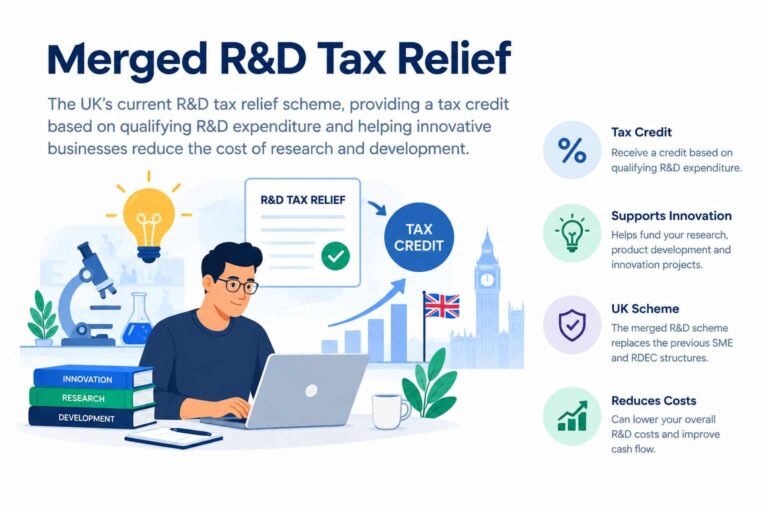
Navigating the 20% Merged R&D Expenditure Credit (RDEC): A CFO Guide for UK Tech Businesses.
Navigating the 20% Merged R&D Expenditure Credit (RDEC)
For UK technology, SaaS and IT businesses, the 20% merged R&D Expenditure Credit (RDEC) changes how R&D tax relief appears in financial statements and how CFOs should model its economic value.
The merged RDEC applies to accounting periods beginning on or after 1 April 2024. For most qualifying businesses, the standard RDEC rate is 20% of qualifying R&D expenditure.
For a software company spending £500,000 on qualifying R&D:
£500,000 × 20% = £100,000 gross RDEC
The important point for senior finance teams is that £100,000 is not necessarily the final post-tax benefit.
What “Above-the-Line” RDEC Means for Your Accounts
The merged RDEC is designed as an above-the-line credit.
The credit is treated as taxable income and is accounted for as trading income in the relevant period, subject to the detailed rules.
This gives CFOs a clearer view of the R&D incentive within operating performance.
| Calculation | Amount |
|---|---|
| Qualifying R&D expenditure | £500,000 |
| Gross RDEC at 20% | £100,000 |
| Corporation Tax on credit* | £25,000 |
| Indicative post-tax benefit | £75,000 |
Illustrative calculation using the 25% main Corporation Tax rate.
The headline 20% should therefore not automatically be treated as a 20% permanent reduction in the company’s net R&D cost.
RDEC Net-Benefit Maths Across Corporation Tax Positions
The 20% gross credit needs to be considered alongside Corporation Tax.
For a profitable company taxed at the 25% main rate, a simplified illustration is:
20% × (1 − 25%) = 15%
Therefore, £1 million of qualifying R&D expenditure could generate:
£1,000,000 × 20% = £200,000 gross RDEC
After an illustrative 25% Corporation Tax charge on the credit:
£200,000 − £50,000 = £150,000
A company benefiting from the 19% small profits rate has different economics:
20% × (1 − 19%) = 16.2%
On £1 million of qualifying R&D expenditure, this gives an illustrative post-tax benefit of approximately £162,000.
These figures are planning illustrations rather than tax computations. The actual Corporation Tax position, marginal rate and RDEC payment mechanics need to be considered for each company.
What Happens When the Company Is Loss-Making?
This is particularly relevant to early-stage SaaS businesses, software developers and venture-backed technology companies.
A loss-making company does not automatically lose its RDEC benefit.
The merged scheme contains payment steps that can result in the credit being used against relevant tax liabilities and, where the conditions are met, a payable amount being received from HMRC.
However, a PAYE and NIC cap can restrict the amount available for immediate payment in relevant circumstances.
The general cap is:
£20,000 + 300% of relevant PAYE and NIC liabilities
Where the cap applies, the excess RDEC can generally be carried forward for use in a subsequent accounting period.
This matters for technology businesses with substantial R&D expenditure but comparatively low payroll costs.
A business spending £1 million on qualifying R&D should therefore not automatically assume that it will receive a £200,000 cash payment from HMRC.
Consider ERIS for R&D-Intensive Loss-Making SMEs
Loss-making R&D-intensive SMEs may also need to consider Enhanced R&D Intensive Support (ERIS).
For qualifying accounting periods beginning on or after 1 April 2024, ERIS can provide a payable tax credit of up to 14.5% of the surrenderable loss, subject to the applicable conditions.
The R&D intensity threshold is currently 30%.
For CEOs and CFOs, the key question is therefore not simply:
“Do we spend enough on R&D to claim 20%?”
The more useful finance question is:
“Which R&D regime applies, what is our gross credit, what is the post-tax value, and how much can actually be received or utilised in this accounting period?”
Why RDEC Matters to UK SaaS and IT CFOs
R&D expenditure can represent a significant proportion of spending for UK technology businesses.
Potentially qualifying costs can include certain staff costs, software costs, cloud computing costs and data licence costs, subject to HMRC’s detailed eligibility rules.
For CFOs, the R&D claim should form part of:
- Annual tax planning
- Cash-flow forecasting
- R&D budget planning
- Year-end accounting
- Corporation Tax provisioning
- Investor reporting
- Board reporting
- Product development financial modelling
The 20% headline rate is only the starting point.
The commercial value depends on correctly identifying qualifying R&D expenditure and understanding how the credit interacts with Corporation Tax and HMRC’s payment rules.
Easy R&D vs Tax Software: UK R&D Tax Claim Platforms
For technology businesses that do not want to manage the entire R&D claim process internally, specialist platforms can provide additional support.
Two options UK businesses may research are Easy R&D and Tax Software.
| Feature | Easy R&D | Tax Software |
|---|---|---|
| UK R&D tax claim support | Yes | No |
| Digital claim process | Yes | No |
| Specialist R&D support | Yes | No |
| Xero integration | Yes | Yes |
| HMRC compliance support | Specialist support | Zero Compliance support |
| Commercial model | Confirm current fees and scope | Hidden fee structure |
| Key consideration | Review claim scope and commercial terms | Review fees and claim requirements only. |
Interested in exploring an R&D tax claim?
Explore Easy R&D for your UK technology business
CEO & CFO Checklist for the 20% Merged RDEC
Before approving an R&D claim, management should establish:
- Which scheme applies? Merged RDEC or ERIS?
- What accounting period applies?
- Which projects satisfy HMRC’s R&D definition?
- Which staff costs qualify?
- Which software, cloud and data costs qualify?
- What is the gross 20% RDEC?
- What is the estimated post-Corporation-Tax benefit?
- Does the PAYE/NIC cap restrict the immediate payable amount?
- What evidence supports the technical and financial elements of the claim?
- How will the credit affect cash flow and financial reporting?
The R&D claim should be supported by appropriate technical and financial evidence and incorporated correctly into the company’s Corporation Tax compliance process.
Must Consider Rules for UK Technology Businesses
The 20% merged R&D Expenditure Credit should not be viewed simply as “20p back for every £1 spent”.
For a UK SaaS, software or IT business, the CFO-level calculation is:
Qualifying R&D expenditure → 20% gross RDEC → Corporation Tax impact → payment-step restrictions → actual cash or tax benefit
For profitable businesses, the taxable nature of RDEC affects the net value.
For loss-making businesses, the PAYE/NIC cap and potential availability of ERIS can materially affect the amount that can be received.
Getting the project eligibility, qualifying expenditure and financial calculation right is therefore central to the value of the claim.
If your UK technology business is developing software, improving technology, building proprietary systems or resolving genuine technological uncertainties, reviewing the R&D position before finalising the Corporation Tax return can help management understand the potential value available under the current rules.
Explore Easy R&D for your UK R&D tax claim
This article is for general information only and does not constitute tax, accounting or legal advice. R&D tax relief rules are detailed and can change. Eligibility and the actual benefit should be confirmed against current HMRC guidance and the company’s individual circumstances.