Entity-Free Global Scaling: How UK Businesses Can Hire Globally Without Local Entities.
Global expansion is no longer limited to businesses with overseas offices and local subsidiaries. UK companies can now access international talent through workforce infrastructure solutions such as Employer of Record (EoR) and Contractor of Record (CoR).
For CEOs and CFOs, these frameworks offer potential flexibility while raising important questions about cost, compliance and financial control.
But what is the difference between EoR and CoR, and which model fits your business?
What Is Entity-Free Global Scaling?
Entity-free global scaling means expanding your international workforce without immediately establishing a company-owned legal entity in every country.
Businesses can use workforce infrastructure providers to support international employment or contractor engagements, depending on the worker’s status and local regulations.
However, avoiding a local entity does not eliminate tax, employment or legal obligations.
1. Employer of Record (EoR)
An Employer of Record is a third-party organisation that formally employs workers on behalf of a client business in another country.
The EoR typically manages payroll, employment documentation and agreed statutory responsibilities, while the client company directs the employee’s daily work.
When Is EoR Useful?
EoR may be suitable for UK businesses that want to:
- Hire overseas employees.
- Test a new international market.
- Access specialist talent.
- Reduce the need for immediate local entity setup.
- Manage international employment administration.
Example: A UK technology company wants to hire a software engineer in Germany but is not ready to establish a German subsidiary. An EoR arrangement may provide an alternative employment structure, subject to local requirements.
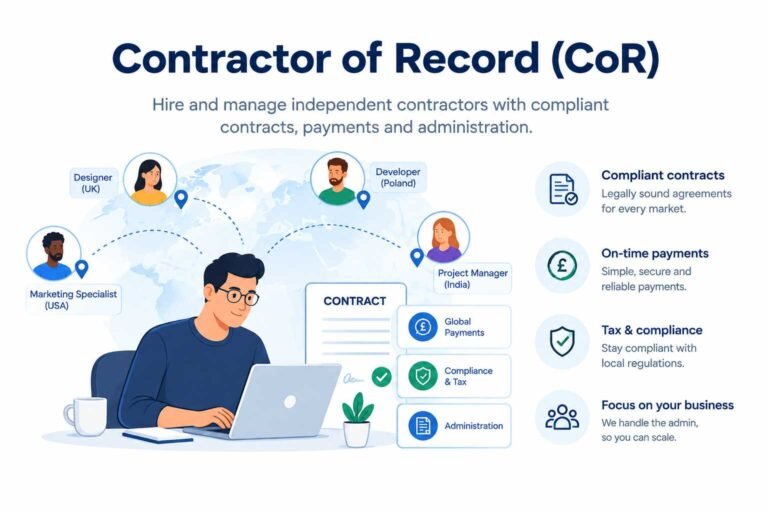
2. Contractor of Record (CoR)
A Contractor of Record supports businesses engaging independent contractors internationally.
Depending on the provider, services may include contractor onboarding, contract administration, classification support and international payments.
However, a contractor’s legal status depends on the actual working relationship, not simply the contract title.
When Is CoR Useful?
CoR may be relevant for businesses that need to:
- Engage genuine independent contractors.
- Hire international project specialists.
- Manage contractor documentation.
- Streamline cross-border payments.
- Review potential classification risks.
Important: A CoR framework does not automatically eliminate misclassification risk. Businesses must assess the engagement under applicable laws.
EoR vs CoR: Key Differences
| Feature | EoR | CoR |
|---|---|---|
| Worker type | Employee | Independent contractor |
| Primary purpose | International employment | Contractor engagement |
| Main focus | Payroll and employment administration | Contractor documentation and payments |
| Key consideration | Employment and tax compliance | Classification and contractual compliance |
| Suitable for | Ongoing employee roles | Genuine independent engagements |
Why CFOs Should Care About Workforce Infrastructure
International hiring involves more than salary or contractor fees.
CFOs should evaluate:
- Total employment or engagement costs.
- Provider fees.
- Employer contributions and benefits.
- Currency and payment expenses.
- Tax and compliance considerations.
- Long-term workforce requirements.
A useful planning principle is:
Total workforce cost = Compensation + Applicable employer costs + Provider fees + Other expenses
Actual costs vary by country, worker type and provider.
How to Choose the Right Model
Before expanding internationally, UK businesses should:
- Define the business objective and target country.
- Determine whether the worker should be an employee or independent contractor.
- Review local legal and tax requirements.
- Compare provider pricing and service scope.
- Assess contractual responsibilities and risks.
- Seek professional advice where required.
Deel and Multiplier: Workforce Infrastructure Options
UK businesses researching international hiring may consider providers such as Deel and Multiplier.
Both offer global workforce solutions, but service availability, pricing, legal structures and contractual terms can vary.
Explore the options:
Review each provider’s terms and confirm that the selected solution fits your business requirements.
Frequently Asked Questions
What is entity-free global scaling?
It is an approach to international workforce expansion that does not require a company to establish its own legal entity in every target country.
Is EoR suitable for UK businesses?
EoR may support UK businesses hiring overseas employees without immediately setting up a local subsidiary, subject to local requirements.
What is the difference between EoR and CoR?
EoR supports employment arrangements, while CoR supports qualifying independent contractor engagements.
Does CoR remove compliance risks?
No. Businesses must still assess worker classification and applicable legal requirements.
Conclusion
Entity-free global scaling can help UK businesses explore international opportunities with greater workforce flexibility.
EoR may suit international employment, while CoR may suit genuine independent contractor engagements.
For CEOs and CFOs, the priority should be selecting a structure that balances growth, cost visibility and compliance.
Before making a decision, compare workforce infrastructure providers and seek appropriate professional advice.
Affiliate Disclosure: This article may contain affiliate links. About Accounting UK may earn a commission if you use a link and purchase a service, at no additional cost to you. This content is for general information and does not constitute legal, tax or employment advice.