Permanent Establishment Firewall: A Practical UK Framework for Managing PE Risk
For a business expanding into the UK, hiring one employee can be commercially straightforward but tax and compliance considerations can become much more complicated.
One issue that deserves attention from the CFO, finance director and senior leadership team is permanent establishment (PE) risk.
A practical way to manage this is to build a Permanent Establishment Firewall: a structured framework designed to identify activities that could create a UK taxable presence, control those risks and document how international employees and operations are managed.
What is a Permanent Establishment Firewall?
A Permanent Establishment Firewall is not a separate UK tax rule or an HMRC-approved legal structure.
It is a management framework for reducing avoidable PE exposure when a non-UK company has people, activities or commercial operations connected with the UK.
Under UK rules, a non-UK resident company can become subject to UK Corporation Tax when it carries on a trade through a UK permanent establishment. HMRC identifies two important routes: a fixed place of business and, subject to the applicable rules, an agent acting on behalf of the company.
That means the real question for leadership is not simply:
“Do we have a UK office?”
It is:
“What business activity is actually being carried out in the UK, by whom, and under whose authority?”
The UK PE Firewall Framework
A useful framework has five layers.
1. People
Start with your UK-based workforce.
Document:
- Where employees work
- Their job responsibilities
- Who manages them
- Whether they negotiate or conclude contracts
- Whether they generate or support revenue
- Whether they represent the overseas company commercially
A UK employee does not automatically create a permanent establishment. However, the activities performed by people in the UK can be relevant to the PE analysis. HMRC notes that personnel working through a fixed place of business can be relevant to establishing a fixed-place PE.
2. Place
Next, examine the physical working environment.
Consider:
- UK offices
- Dedicated desks
- Shared offices
- Customer premises
- Warehouses
- Operational sites
- Other locations effectively available to the business
A fixed place does not necessarily require the company to own or lease an entire office. HMRC guidance explains that a place can potentially be relevant where premises or space are effectively at the enterprise’s disposal.
3. Power
This is one of the most important CFO-level questions.
Ask:
Can someone in the UK habitually conclude contracts, or play a principal role leading to contracts that the overseas company routinely accepts without material modification?
The UK rules applying to accounting periods beginning on or after 1 January 2026 have been updated to align the dependent-agent test more closely with the OECD Model Tax Convention.
Therefore, contract authority and sales responsibilities should be clearly documented rather than left to informal working practices.
4. Profit
If PE exposure exists, the financial question becomes even more important: how much profit is attributable to the UK permanent establishment?
The existence of a PE does not automatically mean that all group profits become taxable in the UK. HMRC states that profit attribution depends on the activities and value associated with the UK PE.
For CFOs, this makes PE monitoring closely connected with:
- Transfer pricing
- Management reporting
- Intercompany arrangements
- Revenue attribution
- Cost allocation
- Tax provisioning
5. Proof
The final firewall is documentation.
A business should be able to explain, consistently and contemporaneously:
- Where employees are located
- What they do
- Who has contractual authority
- How sales are conducted
- Which entity signs customer contracts
- Where strategic decisions are made
- Which entity bears commercial risk
- How intercompany responsibilities are allocated
Good documentation does not eliminate PE risk. But it can make the business’s operating model clearer and help management identify changes before they become tax problems.
Can an Employer of Record help reduce PE risk?
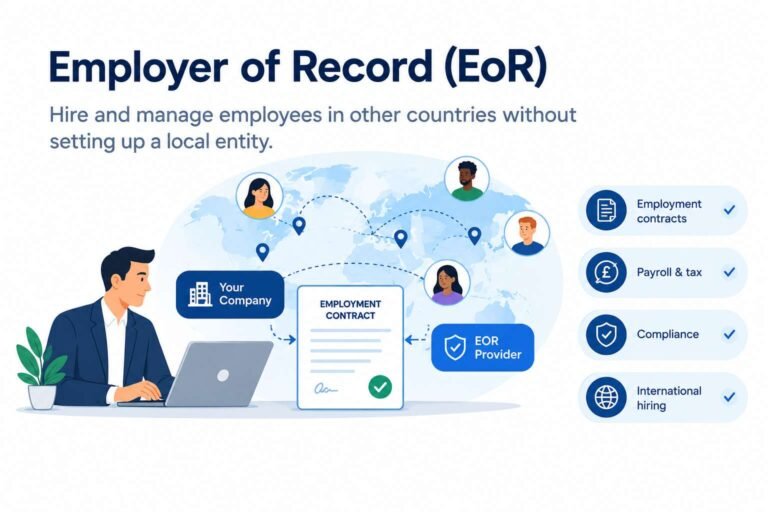
An Employer of Record (EOR) can be part of a PE risk-management strategy when a company wants to hire internationally without immediately establishing its own local entity.
The EOR becomes the legal employer for the worker and handles employment administration such as local payroll and employment compliance. Providers such as Deel and Multiplier position their EOR models as a way to hire internationally without establishing a local legal entity.
However, an important distinction should be made:
An EOR is not a universal “PE shield”.
The underlying business activities still matter. If employees are effectively carrying out the overseas company’s core commercial activities in the UK, the overall arrangement should be reviewed carefully.
For that reason, CEOs and CFOs should assess the employment structure and the actual operating model together, rather than assuming that an EOR automatically removes every UK tax issue.
A CFO’s Permanent Establishment Firewall Checklist
Before expanding a foreign business into the UK, ask:
| Risk area | CFO question |
|---|---|
| People | What will the UK-based worker actually do? |
| Place | Is any UK location effectively available to the business? |
| Contracts | Who negotiates and concludes customer contracts? |
| Revenue | Where are revenue-generating activities performed? |
| Management | Who directs the employee’s commercial activity? |
| Entity | Which company employs the individual? |
| Profit | Could UK activity require profit attribution? |
| Evidence | Can the operating model be demonstrated from written records? |
| Change control | Who reviews PE risk when an employee’s role changes? |
This turns PE management from a once-a-year tax question into an ongoing governance process.
Why CEOs and CFOs should care
PE risk is ultimately a business-model issue, not simply a tax department issue.
A company may begin with one remote employee and later add sales responsibilities, customer negotiations, a UK workspace and additional staff.
The original hiring decision may remain unchanged, while the commercial reality around that employee changes significantly.
That is why an effective Permanent Establishment Firewall should be reviewed whenever there is a material change in:
- Headcount
- Job responsibilities
- Sales activity
- Contract authority
- Office arrangements
- Customer-facing activity
- UK revenue
- Management structure
For a fast-growing international business, early review can be considerably more useful than trying to reconstruct the operating model after a tax concern has emerged.
The Bottom Line
A Permanent Establishment Firewall should be viewed as a practical governance framework for managing UK PE exposure—not as a way to guarantee that a permanent establishment will never arise.
The framework is simple:
People → Place → Power → Profit → Proof
For companies testing the UK market, an Employer of Record can be one possible component of the wider operating model. Businesses can explore providers such as Deel and Multiplier, while obtaining appropriate UK tax advice for their specific circumstances.
The key for senior management is to align the hiring model, commercial activity, contractual authority and tax position before the UK operation scales.
Affiliate disclosure:
About Accounting UK may earn a commission if you use certain links on this page to purchase or enquire about third-party services. This does not change our editorial approach or the information presented. Readers should assess whether a service is appropriate for their own circumstances and obtain professional tax advice where required.
Important note:
This article is for general information only and does not constitute UK tax, legal or accounting advice. Permanent establishment is a fact-sensitive area, and the applicable UK legislation, tax treaty and business circumstances should be considered before making structural decisions.