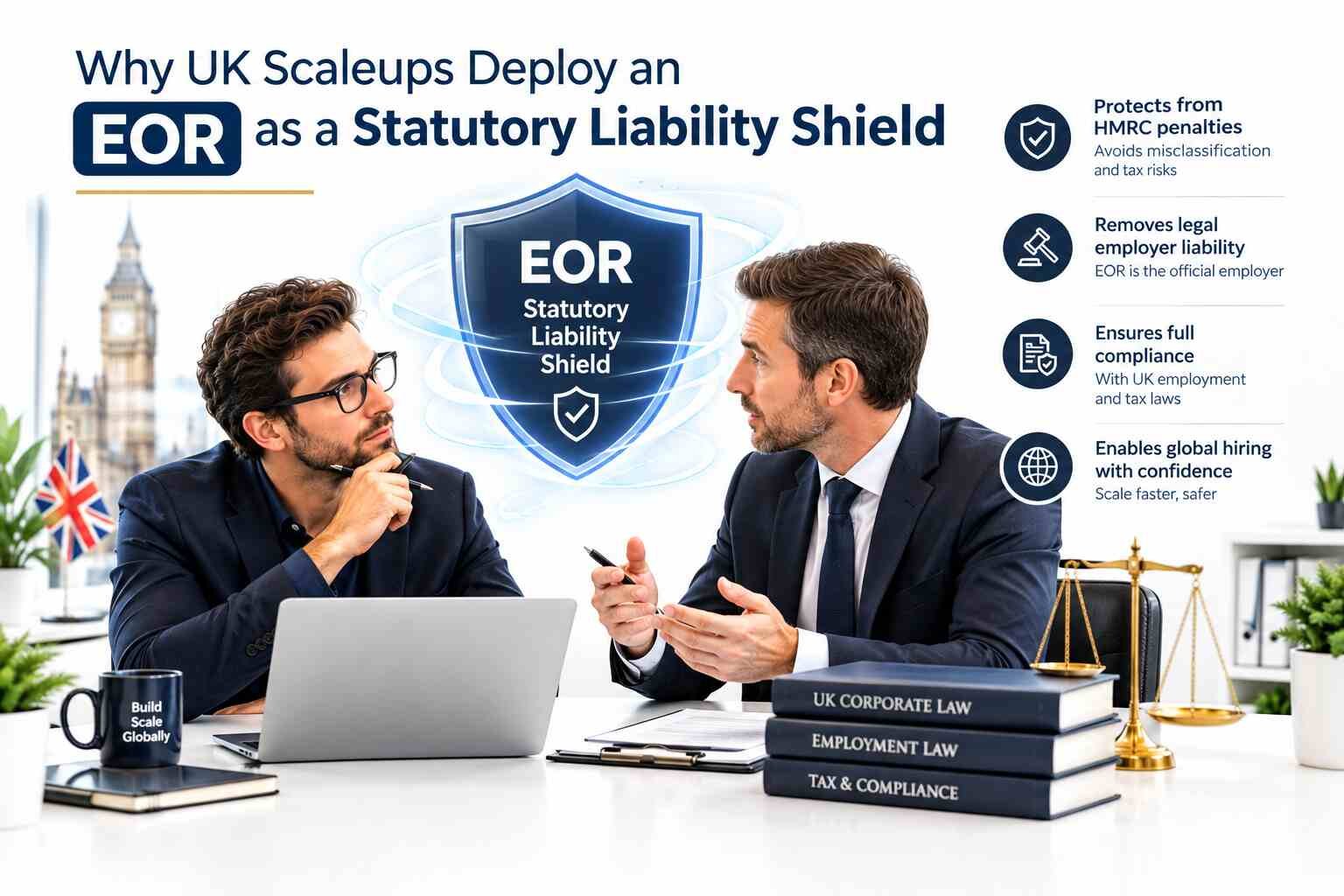
Why UK Scaleups Deploy an EoR as a Statutory Liability Shield
For a growing business, hiring in the UK can be commercially straightforward. The challenge is managing the employment, payroll and statutory obligations that follow.
That is why an increasing number of international businesses consider an Employer of Record (EoR) when entering the UK or expanding their workforce.
An EOR can provide a structured employment layer between a scaleup and the local employment infrastructure. For CEOs and CFOs, the attraction is not simply faster hiring. It is clearer responsibility, controlled administration and a more scalable approach to employment compliance.
This is why an EOR can be viewed as a statutory liability shield — although it should never be treated as a guarantee that every liability transfers away from the business.
What is a statutory liability shield?
“Statutory liability shield” is a practical business term rather than a defined UK legal status.
In an EoR arrangement, the EOR generally becomes the legal employer of the worker and manages agreed employment processes such as payroll, employment documentation and specified statutory requirements.
The client company normally continues to direct the employee’s day-to-day work.
This creates a useful division:
EoR: employment administration and agreed statutory processes
Scaleup: commercial strategy, day-to-day direction and business activity
The precise allocation of responsibilities depends on the EOR agreement and the circumstances of the employment relationship.
For senior management, that distinction is critical.
Why are UK scaleups turning to EoRs?
The traditional alternative to an EOR is establishing a local entity and building the necessary employment infrastructure.
That can make sense when a company has established long-term operations in the UK. But it may be disproportionate when a business is initially hiring one or two employees, testing the market or building an international team.
An EOR can provide a route to employment without requiring the company to immediately create its own local employment structure.
For a scaleup, this can mean:
- Faster international hiring
- Centralised payroll administration
- A defined employment structure
- Less internal HR administration
- Greater consistency across international markets
- A potentially simpler route to initial market entry
Providers such as Deel and Multiplier offer EOR solutions for international hiring, including employment models designed to avoid the immediate need for a locally incorporated entity.
The CFO’s EoR liability framework
The right question is not:
“Does an EoR remove our liability?”
The better question is:
“Which obligations are transferred to the EoR, which remain with us, and how are those responsibilities controlled?”
A CFO can assess an EOR using five areas.
1. Employment:
Identify who legally employs the worker and who is responsible for employment documentation, payroll and agreed statutory processes.
The arrangement should be documented rather than based on assumptions.
2. Payroll and tax administration:
UK employment can involve PAYE, National Insurance, statutory payments and payroll reporting.
Where the EOR is the legal employer, it will generally manage the payroll processes falling within its contractual responsibilities.
The business should nevertheless understand exactly what the provider handles and what information or actions remain its responsibility.
3. Employee management:
An EOR does not normally take over the commercial management of an employee.
The client may continue to determine:
- Job responsibilities
- Performance expectations
- Working objectives
- Reporting lines
- Business priorities
That makes governance important. The operating relationship should match the contractual structure.
4. Liability allocation:
This is the area that deserves the most attention from a CFO.
Before signing an EoR agreement, establish:
- What employment liabilities the provider accepts
- What liabilities remain with the client
- How employment disputes are handled
- Who manages statutory filings
- Who maintains employment records
- What happens if legislation changes
- What indemnities and contractual protections apply
An EOR can help allocate and manage specific employment responsibilities, but it is not a universal legal shield.
5. Scalability:
An EoR becomes particularly useful when international hiring moves beyond a single employee.
A repeatable EoR model can allow a business to enter additional markets without creating a completely different employment process for every new hire.
For a scaleup CFO, that can make international workforce expansion easier to budget, govern and monitor.
EoR versus establishing a UK company
An EoR and a UK subsidiary solve different business problems.
An EoR may be appropriate when the immediate objective is to hire talent or test the market without establishing a standalone local employment structure.
A UK company may become more appropriate when the business develops a substantial and permanent operating presence.
The decision should consider:
| Consideration | EoR model | UK entity |
|---|---|---|
| Initial setup | Generally simpler | More infrastructure required |
| Local employment | Managed through EoR | Managed directly |
| Payroll | EOR-managed under agreement | Company-managed |
| Corporate presence | No separate client entity created by the EOR model | UK entity established |
| Long-term operations | May suit some businesses | May suit established operations |
| Control | Shared according to contractual model | Direct employer control |
Neither structure is automatically appropriate for every business.
The commercial model, workforce, tax position, operating activities and long-term UK strategy should determine the choice.
Does an EoR eliminate UK tax or PE risk?
No.
This is an important distinction for CEOs and CFOs.
An EoR arrangement concerns the employment relationship and associated administration. Permanent establishment, corporation tax, transfer pricing and other tax questions depend on the wider activities of the business.
For example, the activities performed by UK-based personnel, their authority, the location from which business is conducted and the company’s overall operating model may need separate consideration.
Therefore:
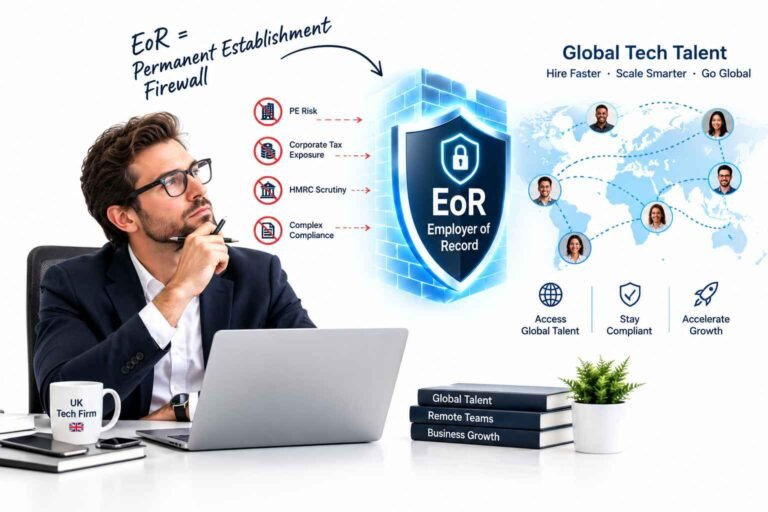
EoR ≠ automatic PE protection
EoR ≠ automatic tax exemption
EoR = a structured employment and compliance model
That distinction can prevent costly assumptions during international expansion.
The 5-question CEO and CFO checklist
Before deploying an EoR, ask:
1. Who is the legal employer?
Make the employment relationship clear.
2. Which statutory responsibilities does the EoR manage?
Document the scope rather than relying on sales explanations.
3. Which liabilities remain with the company?
Review exclusions, indemnities and contractual responsibilities.
4. Does the employee’s actual role match the agreed structure?
Commercial activities should be consistent with the intended operating model.
5. What happens when the business scales?
Ensure today’s EoR solution can support tomorrow’s workforce strategy.
The bottom line:
For UK scaleups, an Employer of Record can be more than a hiring convenience.
Used correctly, it can provide a structured employment and compliance layer that helps businesses manage payroll and defined statutory employment responsibilities while concentrating internal resources on growth.
But an EoR should not be marketed or understood as a blanket “liability shield”.
The strongest approach is to treat it as a liability-allocation and compliance-management framework.
For CEOs and CFOs, the objective is simple:
Know who employs the person, know who manages the obligation, know which liabilities remain with the business, and document the arrangement before scaling.
That is where an EoR can become a strategic part of international workforce planning rather than simply another HR supplier.
Explore EoR options:
If your business is considering international hiring, you can explore EOR options from providers such as Deel and Multiplier through our affiliate links.
Explore Deel EOR → Get A Free Audit with Demo.
Explore Multiplier EOR → Get A Free Audit with Demo
About Accounting UK may receive a commission when readers use certain affiliate links on this website. This does not affect our editorial content or the information presented. Please review each provider’s current terms, pricing and contractual responsibilities before making a decision.
Frequently Asked Questions
Is an EoR a statutory liability shield?
Not in the legal sense. An EOR can assume specified employment and administrative responsibilities under its agreement with the client, but it does not automatically remove every legal, tax or commercial liability.
Why would a UK scaleup use an EoR?
An EOR can allow a business to employ workers through an established local employment structure without immediately creating its own local entity. This can be useful for initial market entry, international recruitment or testing a new market.
Does an EoR handle PAYE?
Where the EOR is the legal employer, it can manage payroll and associated PAYE processes within the scope of the arrangement. The exact division of responsibilities should always be confirmed contractually.
Does using an EoR remove permanent establishment risk?
No. Permanent establishment is a separate tax consideration based on the business’s activities and circumstances. Using an EOR does not automatically prevent a permanent establishment from arising.
Is an EoR suitable for every scaleup?
No. The appropriate structure depends on the company’s workforce, commercial activities, expected duration of operations, tax position and growth plans. An EOR can be one option within a wider international expansion strategy.
Disclaimer: This article is provided for general information and is not UK legal, tax, employment or accounting advice. EoR, employment tax and permanent establishment outcomes are fact-specific. Businesses should obtain appropriate professional advice before implementing an employment structure.