Employer of Record vs UK Limited Company: Which Is Better for Your Business?
Expanding into the United Kingdom presents an important structural decision for international businesses: should you establish your own UK limited company or use an Employer of Record (EoR)?
The answer depends on your hiring plans, financial objectives, operating model and long-term commitment to the British market.
For CEOs and CFOs, this is not simply an HR decision. It can influence operating costs, compliance responsibilities, financial reporting and future expansion.
What is the difference between an EoR and a UK limited company?
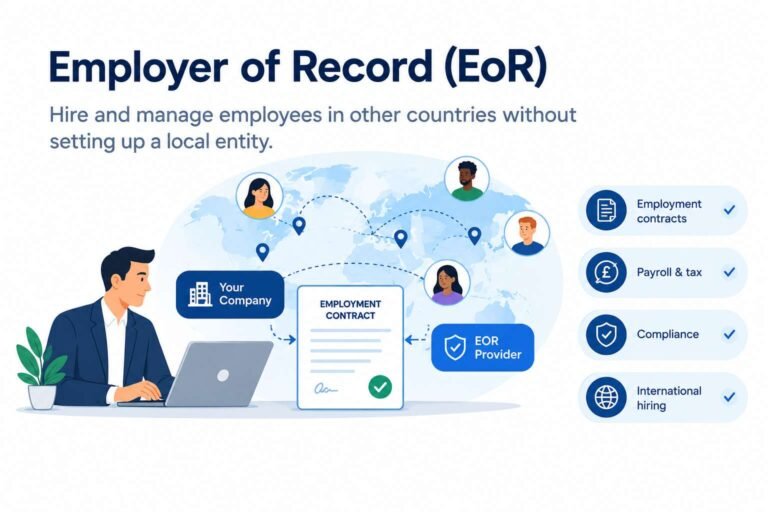
An Employer of Record is a third-party organisation that employs workers on behalf of a client business in a particular country.
A UK limited company is a separate legal entity established under UK company law. It can employ staff, enter contracts and operate a business, subject to the relevant legal and regulatory requirements.
With an EoR, the provider manages defined employment responsibilities. With your own company, your business takes responsibility for its UK employment structure and associated administration.
Employer of Record: How it works
An EoR arrangement typically involves:
- Selecting an EoR provider
- Agreeing employment terms
- Hiring employees through the provider’s local structure
- Managing payroll and statutory employment administration
- Managing employees’ day-to-day responsibilities within your business
The precise allocation of legal responsibilities depends on the arrangement and applicable law.
An EoR can be useful when a company wants to hire UK employees without immediately creating its own employing entity.
UK limited company: How it works
A business establishing a UK limited company generally needs to consider:
- Company registration
- Directors and company governance
- Accounting and financial reporting
- Corporation Tax obligations
- Payroll and PAYE
- Employment compliance
- Banking and business administration
- Relevant commercial and tax requirements
The exact obligations depend on the company’s activities, structure and circumstances.
EoR vs UK company: Cost comparison
The comparison should focus on total cost rather than one registration fee or monthly EoR charge.
EoR costs
Potential costs include:
- Employee salary
- Employer National Insurance
- Pension contributions
- Employee benefits
- EoR management fees
- Currency conversion
- Additional services
UK company costs
Potential costs include:
- Employee salary and employer costs
- Payroll administration
- Accounting fees
- Corporation Tax compliance
- Company secretarial administration
- Banking and software
- Professional advice
- Internal finance and HR resources
A UK company may provide greater control but can require more internal administration.
Which option is suitable for a growing business?
An EoR may be considered when a business:
- Is making its first UK hire
- Wants to test market demand
- Needs to hire international talent
- Wants to avoid immediately establishing an employing entity
- Needs a temporary or exploratory employment structure
A UK company may be worth evaluating when:
- The UK is a core strategic market
- Headcount is expected to grow significantly
- The business needs its own local operating structure
- Commercial activities require a UK presence
- Long-term local investment is planned
These are decision factors, not automatic rules. Tax and legal advice may be necessary.
The permanent establishment question
Establishing a UK company and using an EoR are not interchangeable from a tax perspective.
An EoR does not automatically eliminate the possibility of UK tax or permanent establishment considerations. The company’s actual business activities, authority and operating arrangements matter.
Businesses should seek appropriate professional advice before relying on an EoR as a solution to wider corporate tax questions.
CFO decision framework
Before deciding, compare both models across a 12–36-month planning period.
Ask:
- How many UK employees do we expect to hire?
- Will UK revenue become material?
- Do we need a local commercial presence?
- What is our total employment cost?
- What internal finance resources are available?
- How important is flexibility?
- What are our exit or transition options?
A financial model should include direct costs, indirect administration and expected growth.
Final thoughts
An EoR can provide a practical employment route for businesses entering the UK market. A UK limited company may offer a more permanent structure for organisations building substantial local operations.
The best approach is to compare both options against your company’s strategy and financial projections.
About Accounting researches international employment and accounting-related topics to help businesses make informed decisions. We do not directly provide EoR services.
We may introduce providers such as Deel and Multiplier through affiliate partnerships.
Affiliate disclosure: Some links on About Accounting may be affiliate links. We may earn a commission if you get any services through them, at no additional cost to you.
This article is for general information and does not constitute legal, tax or accounting advice.