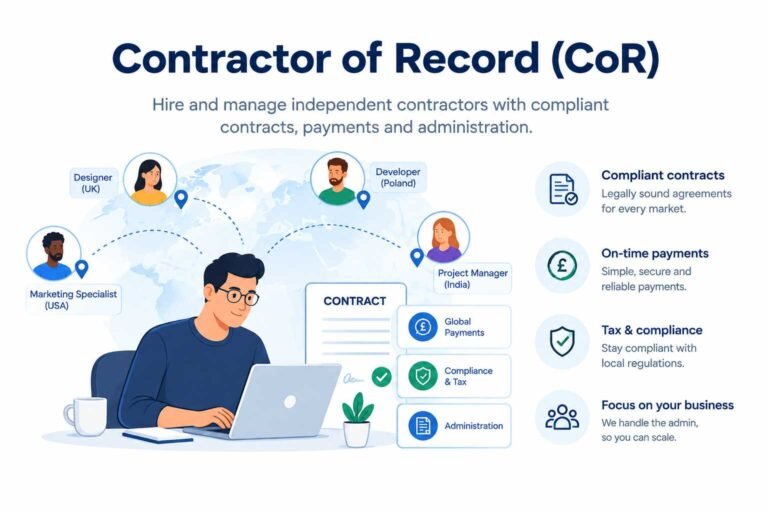

Contractor of Record vs Employer of Record: What Is the Difference?
Contractor of Record vs Employer of Record
CoR is generally designed for independent contractors. EOR is designed for employees.
The simplest distinction is:
CoR is generally designed for independent contractors. EOR is designed for employees.
An Employer of Record becomes the legal employer of an individual while the client business directs the employee’s day-to-day work. A Contractor of Record arrangement, by contrast, is designed around genuine independent contractor engagements.
When should a business use an EOR?
An EOR can be appropriate when a company wants to hire an employee in a country where it does not have its own employing entity.
The EOR typically handles employment administration such as payroll, statutory benefits and local employment compliance.
When should a business use a CoR?
A CoR is more relevant when the individual is genuinely operating as an independent contractor.
This distinction matters.
Simply calling someone a contractor does not automatically make them one. Worker status depends on the facts of the relationship and applicable law.
CoR vs EOR comparison:
| Framework: | Contractor of Record | Employer of Record |
|---|
| Worker | Independent contractor | Employee |
| Main purpose | Contractor engagement | Employment |
| Payroll | Contractor payments | Employee payroll |
| Benefits | Generally contractor arrangement | Statutory/company benefits |
| Classification | Contractor classification is critical | Employee relationship |
| Best for | Flexible/project workforce | Permanent employment |
Deel similarly distinguishes its Contractor of Record offering from its EOR model, with CoR focused on independent contractors and EOR on employees.
The CFO question
The question should not be:
“Which service is cheaper?”
Instead ask:
“What type of worker are we actually engaging?”
Finally, Choosing the wrong workforce model can create unnecessary cost and compliance exposure.
The best approach is to assess the actual working relationship first, then select the appropriate employment infrastructure.