
Employer of Record UK: The Complete Guide for Businesses Hiring.
Hiring someone in UK can look straightforward until the questions start coming.
Who is the legal employer? Who operates PAYE? Who handles National Insurance? What employment rights apply? Do you need a UK company before making your first hire?
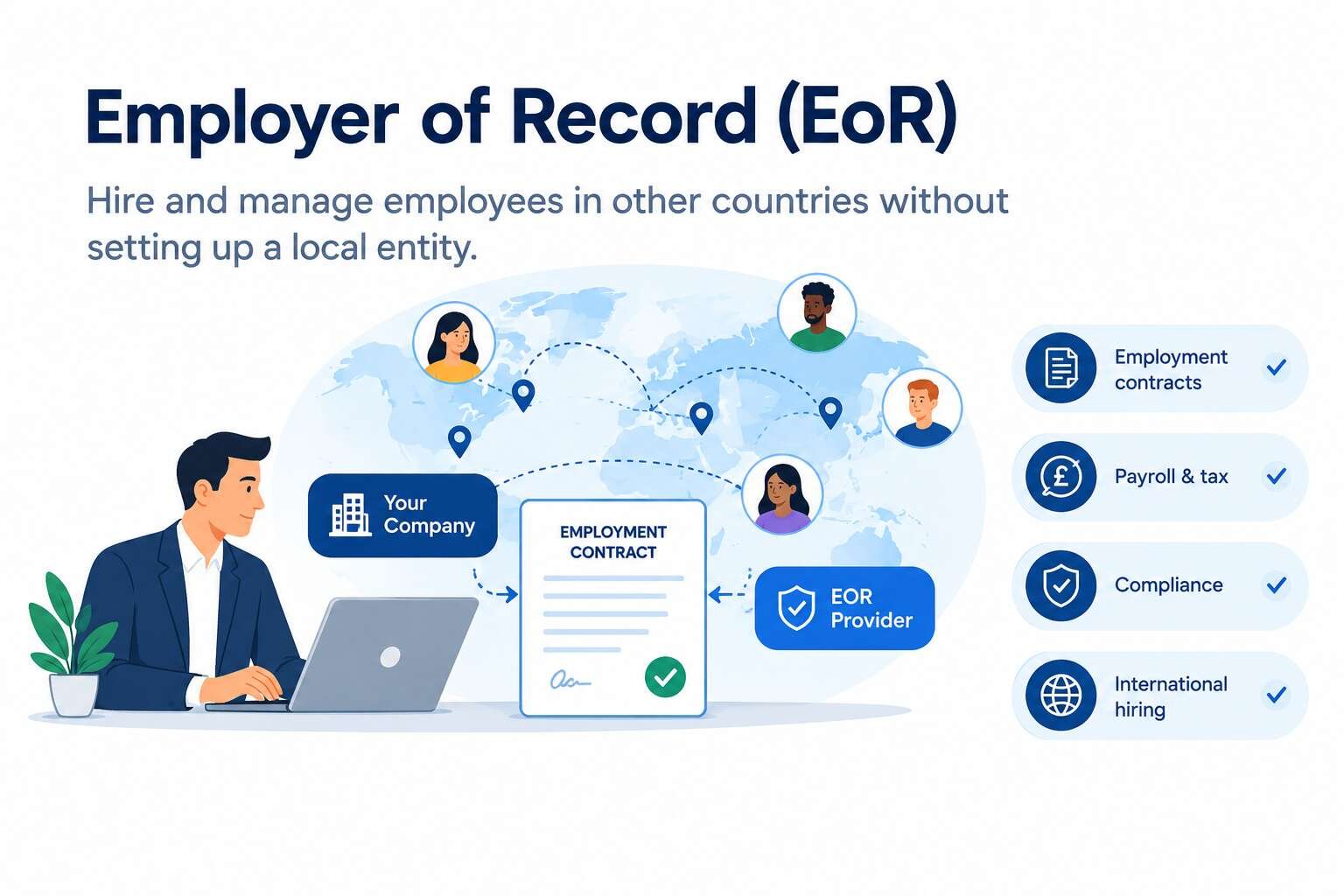
For international businesses, an Employer of Record (EoR) can provide a practical route into the UK employment market without requiring the business to establish its own UK employing entity.
But an EoR is not simply a payroll shortcut. For CEOs and CFOs, the real question is whether the model makes commercial, financial and compliance sense for the company’s UK growth plans.
What is an Employer of Record?
An Employer of Record is a third-party organisation that becomes the formal employer of an employee in a particular country.
The EoR generally takes responsibility for employment administration such as:
- employment documentation
- payroll
- PAYE and applicable tax administration
- National Insurance
- statutory employment obligations
- employee benefits administration
- certain HR and compliance processes
The client business continues to manage the employee’s day-to-day work, objectives, performance and commercial responsibilities.
In simple terms, the EoR handles much of the employment infrastructure while the client focuses on the employee and the business.
Do you need a UK company to hire someone in UK?
Not necessarily.
An international business may choose to establish its own UK entity or use an EoR arrangement, depending on its circumstances and long-term strategy.
For a company testing the UK market with one or several employees, an EoR can reduce the administrative burden associated with establishing and operating a local employment structure.
However, an EoR should not be treated as a universal solution.
If a company intends to build a substantial UK operation, sign commercial contracts locally or establish a significant permanent presence, creating its own UK structure may eventually become more appropriate.
Lorem ipsum dolor sit amet consectetur adipiscing elit duis tristique. Nunc consequat interdum varius sit amet mattis vulputate enim. Faucibus et molestie ac feugiat sed lectus vestibulum mattis. Massa sed elementum tempus egestas sed sed. Nunc consequat interdum varius sit amet. Neque vitae tempus quam pellentesque nec. Cursus metus aliquam eleifend mi. Eu scelerisque felis imperdiet proin fermentum leo vel orci. Quam elementum pulvinar etiam non quam lacus suspendisse faucibus interdum. Non enim praesent elementum facilisis leo vel fringilla. Nisi vitae suscipit tellus mauris a diam maecenas sed. Lorem sed risus ultricies tristique nulla. Elementum facilisis leo vel fringilla. Ut tortor pretium viverra suspendisse potenti. Diam in arcu cursus euismod quis viverra. Mattis vulputate enim nulla aliquet porttitor. Lorem ipsum dolor sit amet consectetur adipiscing. Libero id faucibus nisl tincidunt eget nullam non. Libero nunc consequat interdum varius.
How does a UK EoR work?
The process normally looks something like this:
1. Select an EoR provider: The business evaluates providers based on coverage, pricing, compliance capability, payroll, HR support, technology and service quality.
2. Agree the employment arrangement: The employee is employed through the EoR’s local employing structure.
3. Prepare the employment documentation: The employment relationship must reflect applicable UK requirements.
4. Onboard the employee: The EoR manages relevant employment administration, while the client manages the employee’s operational responsibilities.
5. Run payroll: Salary, tax, National Insurance and applicable benefits are administered through the employment structure.
6. Manage the ongoing employment relationship: The client remains involved in managing the employee’s work, while the EoR supports the formal employment administration.
What should CFOs look at before choosing an EoR?
Price is important, but it should not be the only financial metric.
A CFO should examine the total employment cost.
That may include:
- employee salary
- employer National Insurance
- pension contributions
- statutory benefits
- optional employee benefits
- EoR service fees
- currency conversion costs
- onboarding charges
- termination charges
- immigration-related costs where applicable
A provider with the lowest advertised monthly fee may not produce the lowest total cost.
What should CEOs consider?
For a CEO, the strategic question is different.
S/he ask him/her self
Will an EoR help us enter the UK market quickly without creating unnecessary structural complexity?
If the answer is yes, EoR can be particularly useful during an early market-entry phase.
If the business already knows that it will build a substantial UK operation, the decision should be compared against establishing a UK entity.
Is an EoR a way to avoid UK employment law?
An EoR may be worth considering when a business:
- wants to hire its first UK employee
- is testing the UK market
- needs UK talent quickly
- does not yet want to establish a local entity
- is expanding internationally
- wants to centralise international employment administration
It may be less attractive when the company already has a sizeable UK operation and expects significant long-term headcount growth.
Final decision: speed versus structure.
The strongest reason to consider an EoR is not simply convenience.
It is flexibility.
A business can potentially access UK talent while postponing the administrative commitment associated with building its own employment infrastructure.
Before choosing a provider, compare pricing, contract terms, payroll capability, UK compliance support, employee benefits, customer support and exit arrangements.
About Accounting’s EoR approach
About Accounting does not directly provide Employer of Record services. We research and compare international employment solutions so businesses can make better-informed decisions.
If you are considering an EoR provider, compare established platforms such as Deel and Multiplier, review their current commercial terms and choose the arrangement that fits your hiring strategy.
Affiliate disclosure: Some links on About Accounting may be affiliate links. If you hire a talent through one of these links, we may receive a commission at no additional cost to you and your company. Our editorial recommendations are based on the information and criteria we consider relevant to businesses.This article is for general information and should not be treated as legal, tax or employment-law advice.