UK Employment Law for Overseas Companies: What CEOs and CFOs Need to Know
Hiring employees in the United Kingdom can help international companies access skilled talent and expand their operations.
However, overseas businesses must understand that employing workers in Britain involves specific legal and administrative considerations.
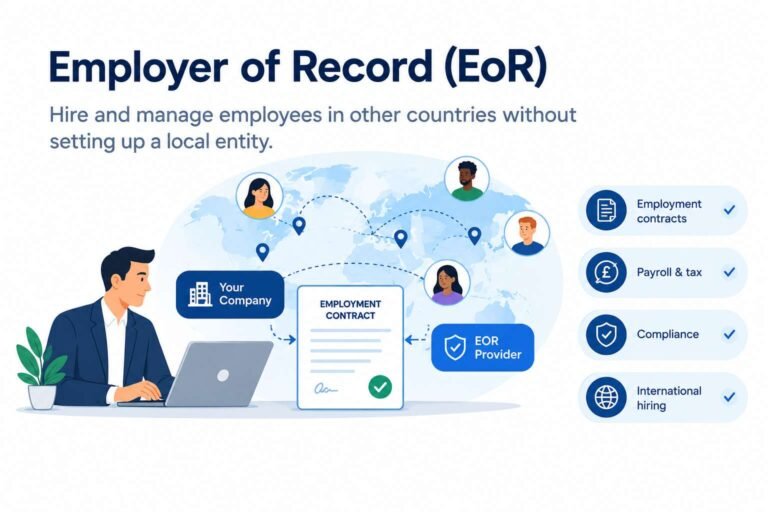
An Employer of Record (EoR) may help manage defined employment responsibilities, but it does not mean the client business can ignore its wider legal, tax or operational obligations.
This guide covers the main areas international companies should review before hiring in the UK.
Why does UK employment law matter to overseas companies?
Employment relationships in the UK are subject to relevant legal requirements.
The exact rules depend on the employee’s circumstances, location, employment terms and other factors.
Companies should understand their responsibilities relating to:
- Employment contracts
- Pay
- Working time
- Holiday entitlement
- Family-related leave
- Sickness absence
- Equality and discrimination
- Termination
- Right to work
- Employee data
A suitable employment structure can help organise administration, but businesses should obtain professional advice when necessary.
Written employment terms
Employees are generally entitled to receive written information about key employment terms.
The employment documentation should reflect the applicable legal requirements and the actual employment arrangement.
Before hiring, companies should review:
- Job title
- Pay
- Working hours
- Place of work
- Holiday entitlement
- Notice arrangements
- Benefits
- Other required terms
The contract should be prepared and reviewed appropriately.
National Minimum Wage
UK minimum wage requirements apply according to the relevant rules and employee circumstances.
An international company should verify the applicable rate rather than rely on outdated information.
Salary planning should account for the legal minimum as well as the market rate for the position.
Working time and holiday
UK employment arrangements can involve working-time and statutory holiday considerations.
Businesses should understand how holiday entitlement is calculated and administered.
Where employees work across countries or have unusual working arrangements, specialist advice may be appropriate.
Equality and discrimination
UK equality law provides protections against unlawful discrimination.
Companies should consider equality obligations during:
- Recruitment
- Pay decisions
- Promotion
- Performance management
- Workplace conduct
- Termination
A global HR policy should not automatically be assumed to meet every UK legal requirement.
Termination and redundancy
Ending an employment relationship requires careful attention to the applicable rules and contractual terms.
Depending on the circumstances, businesses may need to consider:
- Notice
- Contractual rights
- Statutory requirements
- Redundancy
- Consultation
- Final payments
- Accrued holiday
- Potential claims
The EoR agreement should explain the provider’s role in termination processes.
Right to work
Employers must consider right-to-work requirements before employing workers in the UK.
The correct checks depend on the individual’s circumstances.
Businesses should confirm the process and responsibilities with their provider or relevant professional adviser.
How can an EoR support overseas companies?
An EoR may provide support with defined employment administration, such as:
- Employment documentation
- Payroll
- Statutory processes
- Benefits administration
- Employee onboarding
- HR support
The exact scope varies. An EoR should not be presented as a guarantee of complete legal compliance across every aspect of a client’s business.
CFO checklist
Before approving a UK employment arrangement, review:
- Employment costs
- Payroll responsibility
- Employment contract
- Benefits
- Statutory obligations
- Termination process
- Data handling
- Tax and permanent establishment considerations
- Provider contract
Final thoughts
UK employment law is an important consideration for any international company hiring in Britain.
An EoR may help organise local employment administration, but businesses should understand the arrangement and obtain professional advice where required.
About Accounting researches accounting and international employment topics to help businesses make informed decisions.
Affiliate disclosure: About Accounting may earn commissions from eligible affiliate purchases.
This article is general information and is not legal, tax or employment advice.