Can a US Company Hire Employees in the UK Without a UK Entity?
A US company may want to hire a developer in London, a finance professional in Manchester or a sales executive in Edinburgh without establishing a UK subsidiary.
This is a common international expansion question: Can a US business hire employees in Britain without creating its own UK company?
The answer depends on the employment structure, the worker’s circumstances and the company’s wider UK activities.
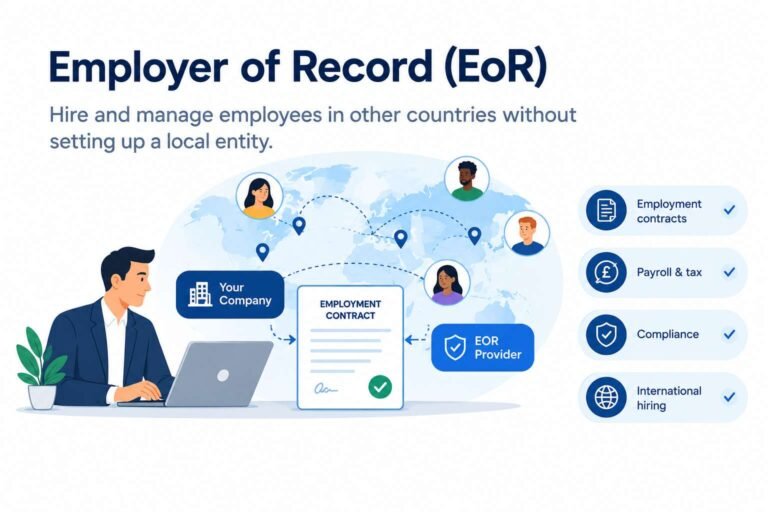
An Employer of Record (EoR) is one option that businesses can evaluate.
Can a US company hire someone in the UK?
A US company can explore different ways to engage talent in the United Kingdom.
Potential options include:
- Establishing a UK employing entity
- Using an Employer of Record
- Engaging a genuine independent contractor, where appropriate
- Using another compliant employment structure
The appropriate choice depends on the relationship, commercial activity and applicable legal and tax requirements.
How does an EoR help?
An EoR provider can employ the worker through its local employment structure.
The US company generally manages the employee’s day-to-day work, while the EoR manages agreed employment administration.
This can allow a business to explore UK hiring without immediately creating its own UK employing entity.
The provider’s responsibilities should be documented in the contract.
What about UK payroll?
A UK employee may create payroll and employment obligations.
These can include:
- PAYE
- Employer National Insurance
- Workplace pension requirements
- Statutory employment rights
- Employment documentation
- Payroll reporting
HMRC publishes guidance for employers on PAYE and National Insurance. A US company should ensure it understands the relevant obligations and the scope of any outsourced arrangement.
Does a US company need a UK subsidiary?
Not necessarily for every hiring arrangement.
However, businesses should not assume that avoiding a UK subsidiary removes all UK tax or legal considerations.
The nature of the employee’s work, the company’s activities and the wider operating model can affect the analysis.
A business should seek appropriate advice before proceeding.
EoR vs UK subsidiary
| Factor | EoR | UK subsidiary |
|---|---|---|
| Initial structure | Uses provider’s employment arrangement | Establishes own company |
| Employment administration | Defined responsibilities outsourced | Managed by the company |
| Control | Client manages daily work; legal roles depend on arrangement | Company controls its employment structure |
| Ongoing costs | EoR fee plus employment costs | Corporate and employment administration |
| Long-term flexibility | Can suit exploratory hiring | Can suit a permanent local operation |
| Tax considerations | Requires wider analysis | Requires corporate and employment tax analysis |
This table is a planning framework, not legal advice.
What should a US CFO consider?
A CFO should model the following:
- Employee salary
- Employer National Insurance
- Pension contributions
- EoR service fees
- Benefits
- Currency conversion
- Professional advice
- Potential entity setup costs
- Long-term hiring projections
A comparison should cover the expected planning horizon rather than only the first month.
Right-to-work requirements
UK right-to-work requirements must be considered when hiring employees.
The applicable process depends on the worker’s nationality, immigration status and circumstances.
An EoR provider may offer support with certain processes, but businesses should confirm what is included and whether immigration advice is required.
When should a US company consider its own UK entity?
A UK entity may be worth evaluating when the business:
- Expects sustained UK growth
- Needs a local commercial structure
- Plans to employ a larger team
- Requires direct control over local operations
- Has long-term UK investment plans
An EoR can remain one option during the assessment of an expansion strategy.
Final thoughts
A US company considering its first UK hire should compare the available employment structures before making a decision.
An EoR may offer a practical route for certain businesses, while a UK company may be appropriate for a more established operating model.
About Accounting helps businesses research these options and may introduce providers such as Deel and Multiplier through affiliate links.
Affiliate disclosure: We may earn a commission from eligible affiliate purchases.
This article is for general information and does not constitute legal, tax or immigration advice.