ERIS vs Merged R&D Scheme: What UK Tech Scaleups Need to Know
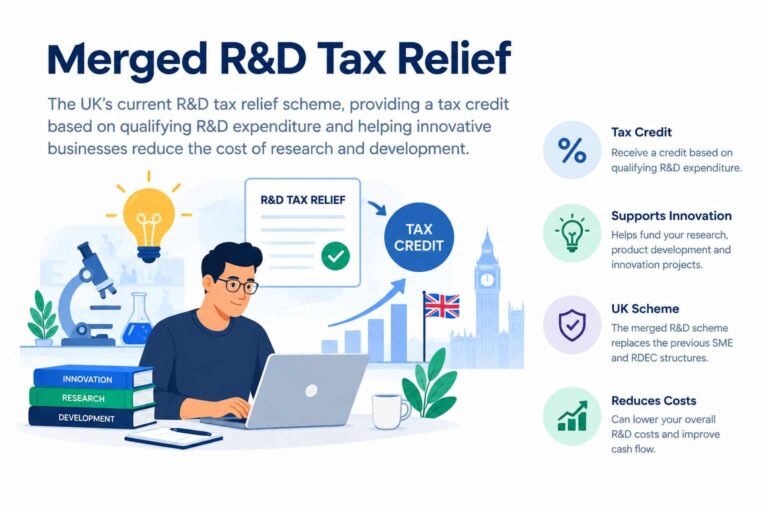
For UK technology, SaaS and software scaleups, the R&D tax relief landscape changed significantly from accounting periods beginning on or after 1 April 2024. The old SME and RDEC schemes no longer apply to most new periods. Businesses now generally consider the Merged R&D Expenditure Credit (RDEC) or, where the conditions apply, Enhanced R&D Intensive Support (ERIS).
For CFOs and finance directors, the key question is not simply “Do we qualify for R&D tax relief?” It is:
Which regime applies to our business, and which qualifying expenditure can we legitimately claim?
ERIS vs Merged R&D Scheme: Quick Comparison
| Factor | Merged R&D Scheme | ERIS |
|---|---|---|
| Primary target | Most companies carrying out qualifying R&D | Loss-making, R&D-intensive SMEs |
| R&D intensity test | No 30% intensity threshold | Generally requires R&D expenditure of at least 30% of total expenditure |
| Profit/loss position | Can apply to profitable and loss-making companies | Company must meet the loss-making condition |
| Credit mechanism | Taxable R&D expenditure credit | Enhanced support through an additional deduction |
| Rate/relief structure | 20% headline expenditure credit, subject to the rules | Additional 86% deduction for qualifying expenditure |
| Can both apply to the same expenditure? | No | No |
HMRC confirms that the qualifying expenditure rules broadly align between the two regimes, while the calculation of the benefit differs. An eligible company can choose to claim under the Merged Scheme instead of ERIS, but it cannot claim both schemes for the same expenditure.
Why ERIS Matters for R&D-Intensive Tech Scaleups
ERIS specifically targets loss-making, R&D-intensive SMEs.
For accounting periods beginning on or after 1 April 2024, HMRC generally requires relevant R&D expenditure to represent at least 30% of total expenditure to satisfy the intensity condition. Connected companies can also affect this calculation.
This can make ERIS particularly relevant to technology businesses that continue to invest heavily in:
- SaaS platform development
- Artificial intelligence and machine learning
- Cybersecurity technology
- Cloud infrastructure
- New software architecture
- Data-intensive products
- Advanced automation
- Technical proof-of-concept work
- New algorithms and complex integrations
However, a high R&D budget alone does not guarantee ERIS eligibility. Your company also needs to satisfy the relevant SME and loss-making conditions.
The Merged R&D Scheme: The Wider Route:
The Merged Scheme provides a 20% taxable R&D expenditure credit and covers a much wider population of companies, including SMEs and larger businesses.
For a growing SaaS business, this can become particularly important as the company moves from early-stage development towards commercial scale.
A business may move between different eligibility positions as its:
- Revenue changes
- R&D expenditure changes
- Profitability changes
- Group structure changes
- Connected-company position changes
- UK and overseas R&D arrangements change
CFOs should therefore review R&D eligibility as part of the annual tax planning cycle rather than treating the claim as a one-off exercise.
The Key Drivers Behind the Correct R&D Relief
1. R&D intensity:
The 30% R&D intensity threshold remains one of the most important ERIS tests. Calculate the percentage carefully and consider connected companies where HMRC rules require them.
2. Profit or loss position:
ERIS focuses on qualifying loss-making R&D-intensive SMEs. If your business makes a taxable profit before the relevant adjustment, the Merged Scheme may become the applicable route instead.
3. Qualifying R&D expenditure:
Your technology spend must connect to qualifying R&D activity. HMRC focuses on scientific or technological advances and genuine technological uncertainty rather than simply describing ordinary software development as R&D.
4. Group structure:
Connected companies can influence both eligibility and the R&D intensity calculation. Scaleups backed by group companies, holding structures or international operations should review the wider corporate structure before submitting the claim.
5. Overseas R&D:
The post-April-2024 rules introduced restrictions around certain overseas R&D expenditure. UK tech companies using overseas developers, contractors or R&D teams should review these costs carefully rather than automatically including them in the claim.
6. HMRC claim compliance:
The financial calculation represents only part of the process.
Companies may need to submit an Additional Information Form (AIF) and, where the rules require it, a Claim Notification Form (CNF). HMRC states that failing to meet mandatory claim requirements can make an R&D claim invalid.
What Should a UK Tech CFO Do Next?
Before your next R&D tax claim, review four numbers:
Qualifying R&D spend + total expenditure + taxable profit/loss + connected-company position.
Then assess the technical evidence behind the projects.
For software businesses, strong evidence can include technical specifications, development records, testing documentation, architecture decisions, failed approaches and records showing how your team addressed technological uncertainty.
The PAYE cap also matters. HMRC currently states that the cap for both Merged RDEC and ERIS generally uses £20,000 plus 300% of relevant PAYE and National Insurance liabilities, subject to the applicable rules and exemptions.
Make Your R&D Claim Decision With Better Evidence
The ERIS vs Merged R&D Scheme decision depends on your company’s actual financial position, R&D intensity, group structure and qualifying expenditure.
For a UK tech scaleup, the cost of getting the classification or supporting evidence wrong can extend beyond the value of the immediate claim.
If you want a specialist to assess your company’s R&D position, you can start with Easy R&D’s eligibility assessment. Easy R&D states that it supports UK businesses through the R&D tax relief process and offers an eligibility assessment for businesses considering a claim.
👉 Check Your R&D Tax Relief Eligibility with Easy R&D:
Final Takeaway
ERIS and the Merged R&D Scheme serve different parts of the UK R&D tax relief landscape.
ERIS centres on loss-making, R&D-intensive SMEs that satisfy the intensity test. The Merged Scheme covers a broader range of companies and provides a taxable R&D expenditure credit.
For technology scaleups, the right approach starts with accurate R&D identification, robust cost allocation, connected-company analysis and timely HMRC compliance.
If your business invests heavily in software, SaaS, AI, cybersecurity or other technology development, checking your eligibility before preparing the claim can help your finance team identify the correct relief and build stronger supporting evidence.
👉 Start Your Easy R&D Eligibility Assessment:
This website provides general information and does not constitute tax advice. R&D tax relief eligibility depends on the company’s specific circumstances and HMRC’s applicable rules.