How Much R&D Tax Relief Can a UK Company Claim?
One of the first questions businesses ask when they discover UK R&D tax relief is simple: how much could we actually claim?
The answer depends on several factors, including the company’s accounting period, the R&D scheme that applies, the amount of qualifying expenditure and the company’s tax position.
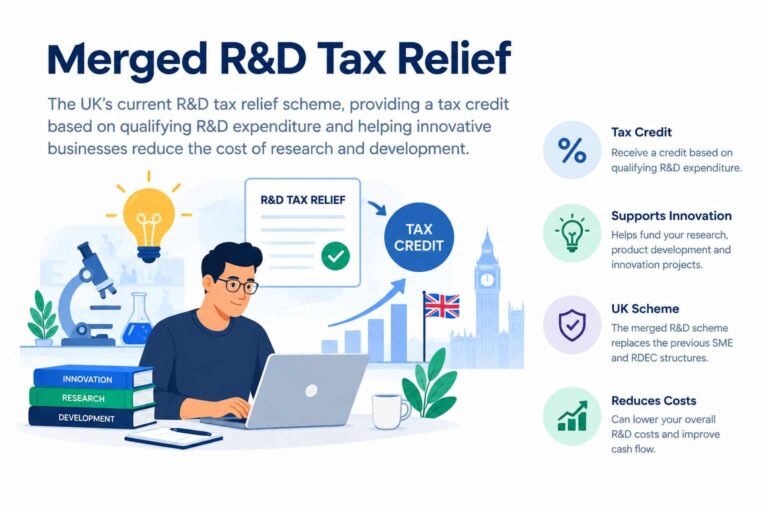
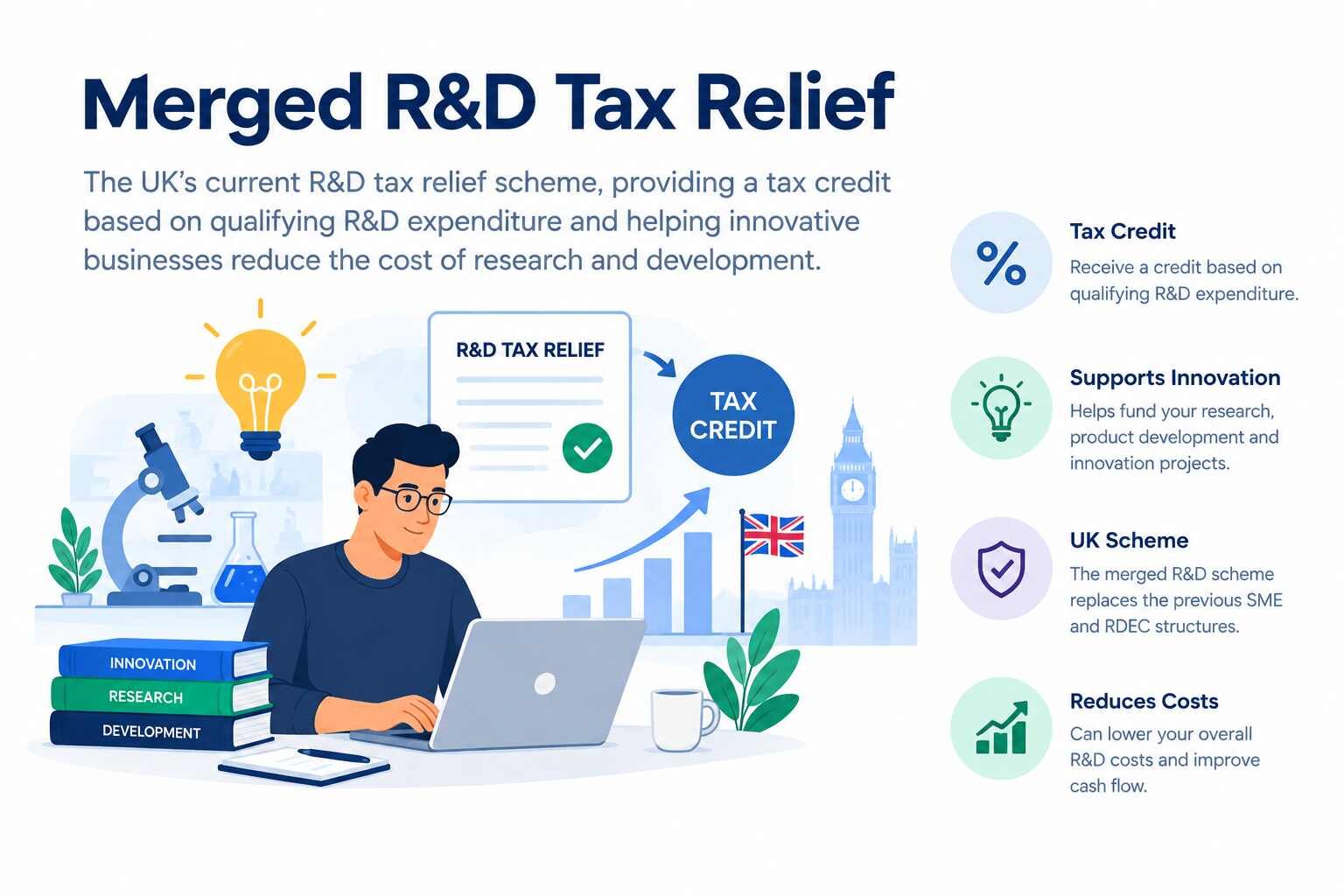
For accounting periods beginning on or after 1 April 2024, many companies fall under the UK’s merged Research and Development Expenditure Credit (RDEC) scheme. The headline rate under the merged scheme is generally 20% of qualifying R&D expenditure.
However, a 20% credit rate does not mean a company automatically receives 20% of its total development spending.
The calculation is more nuanced.
This guide explains how R&D tax relief is calculated in the UK, what expenditure may qualify and what CEOs, CFOs and finance directors should consider when estimating the potential benefit.
What Is the Current R&D Tax Relief Rate in the UK?
For qualifying accounting periods under the merged RDEC scheme, the headline R&D Expenditure Credit rate is generally 20% of qualifying R&D expenditure.
The credit is taxable, meaning the headline rate should not be confused with the company’s final net benefit.
For example, if a company identifies £100,000 of qualifying R&D expenditure, a simple headline calculation would be:
£100,000 × 20% = £20,000 R&D Expenditure Credit
This is an illustrative calculation rather than a guarantee of the amount the company will ultimately receive.
The actual treatment can depend on the company’s tax position and the detailed R&D tax relief rules.
What Does “Qualifying Expenditure” Mean?
This is one of the most important concepts in an R&D tax relief calculation.
A company may spend £500,000 developing a new product, for example, but that does not automatically mean the full £500,000 qualifies for R&D tax relief.
Only expenditure that meets the applicable qualifying criteria should be included.
Potentially relevant categories can include certain:
- Employee costs
- Software costs
- Subcontracted R&D expenditure
- Consumable materials
The precise treatment depends on the relevant legislation and the company’s circumstances.
Therefore, a useful calculation starts with qualifying expenditure, not the company’s total development budget.
A Simple R&D Tax Relief Calculation Example
Consider a fictional UK technology company.
During its accounting period, the company spends:
- £250,000 on eligible employee costs
- £40,000 on qualifying software
- £30,000 on qualifying materials
- £20,000 on potentially qualifying R&D subcontracting
Assume, for illustration, that the entire £340,000 meets the relevant qualifying criteria.
The simplified calculation would be:
£340,000 × 20% = £68,000
The £68,000 represents the headline R&D Expenditure Credit before considering the tax treatment and other relevant adjustments.
This example demonstrates why identifying eligible expenditure accurately is so important.
If a business incorrectly treats all development spending as qualifying, the resulting calculation could be overstated.
Does the 20% Rate Mean the Company Receives £20,000 in Cash?
Not necessarily.
This is a common misunderstanding.
The merged RDEC is a taxable expenditure credit. The final benefit depends on the company’s circumstances and the applicable rules.
Consequently, businesses should not assume that:
Qualifying expenditure × 20% = guaranteed cash received
Instead, the calculation should be viewed as the starting point for understanding the potential credit.
CFOs should incorporate the relevant tax treatment into their financial modelling before using an R&D benefit in cash-flow forecasts.
What If My Company Spends £1 Million on R&D?
Suppose a company has £1 million of expenditure that is confirmed as qualifying R&D expenditure.
A simple headline calculation would be:
£1,000,000 × 20% = £200,000
Again, this is an illustrative gross credit calculation.
It does not mean that the company will necessarily receive £200,000 as cash.
The final treatment depends on the company’s circumstances and the rules applicable to the claim.
This distinction becomes increasingly important for larger businesses because even small differences in qualifying expenditure can materially affect the overall calculation.
What If Only Part of the Company’s Costs Qualify?
This is often the more realistic scenario.
Imagine a company spends £1 million on product development, but after reviewing the projects and expenditure, only £600,000 is eligible.
The simplified calculation would be:
£600,000 × 20% = £120,000
The calculation therefore depends heavily on correctly identifying qualifying expenditure.
This is why companies should avoid estimating their potential R&D tax benefit solely by applying the headline percentage to their entire technology, development or innovation budget.
Can Loss-Making Companies Benefit From R&D Tax Relief?
Potentially, yes.
The treatment of the R&D credit for a loss-making company can differ from that of a profitable company.
In addition, qualifying R&D-intensive loss-making SMEs may need to consider the Enhanced R&D Intensive Support (ERIS) regime, subject to the applicable conditions.
ERIS has separate eligibility requirements and should not be confused with the standard merged RDEC calculation.
Businesses should therefore assess their financial position alongside their R&D activity.
What Is Enhanced R&D Intensive Support?
Enhanced R&D Intensive Support is designed for qualifying loss-making SMEs that meet the relevant R&D intensity threshold.
The rules are separate from the standard merged RDEC scheme.
Eligibility can depend on factors such as:
- The company’s size
- Its loss-making position
- The proportion of expenditure attributable to qualifying R&D
- The relevant accounting period
- Other statutory conditions
Because the R&D-intensive rules can be more complex, companies should verify their eligibility rather than assuming that being an R&D-intensive business automatically qualifies them.
How Do Employee Costs Affect the Calculation?
Employee expenditure can represent a substantial proportion of R&D costs, particularly for software, engineering and technology businesses.
However, businesses should distinguish between employees working on qualifying R&D and employees performing activities that do not meet the relevant criteria.
For example, suppose a software developer spends:
- 60% of their working time on qualifying R&D
- 40% on routine maintenance and other commercial work
The company should not automatically treat 100% of that employee’s cost as qualifying R&D expenditure.
A reasonable and supportable approach to identifying qualifying activity is therefore important.
How Do Software Costs Affect an R&D Claim?
Software can be an important R&D expenditure category for technology businesses.
However, not every software subscription, licence or technology expense automatically qualifies.
The business should examine how the software was used in the R&D activity and whether the expenditure satisfies the applicable rules.
This is particularly important for companies with large technology sta