UK Merged R&D Tax Relief: A Complete Guide for Businesses
Research and development can be one of the most important investments a growing business makes. From developing new software to improving manufacturing processes, solving complex technical problems can require substantial investment in people, technology and resources.
For eligible UK companies, R&D tax relief can help reduce the financial cost associated with qualifying research and development.
The UK’s R&D tax relief rules have changed significantly in recent years. For accounting periods beginning on or after 1 April 2024, the merged R&D Expenditure Credit (RDEC) scheme became the main R&D tax relief scheme for many companies.
For CEOs, CFOs and finance directors, understanding the current rules is important when assessing innovation expenditure, tax planning and financial risk.
This guide explains what UK merged R&D tax relief is, how it works, which costs may qualify and what businesses should consider before making a claim.
What Is UK Merged R&D Tax Relief?
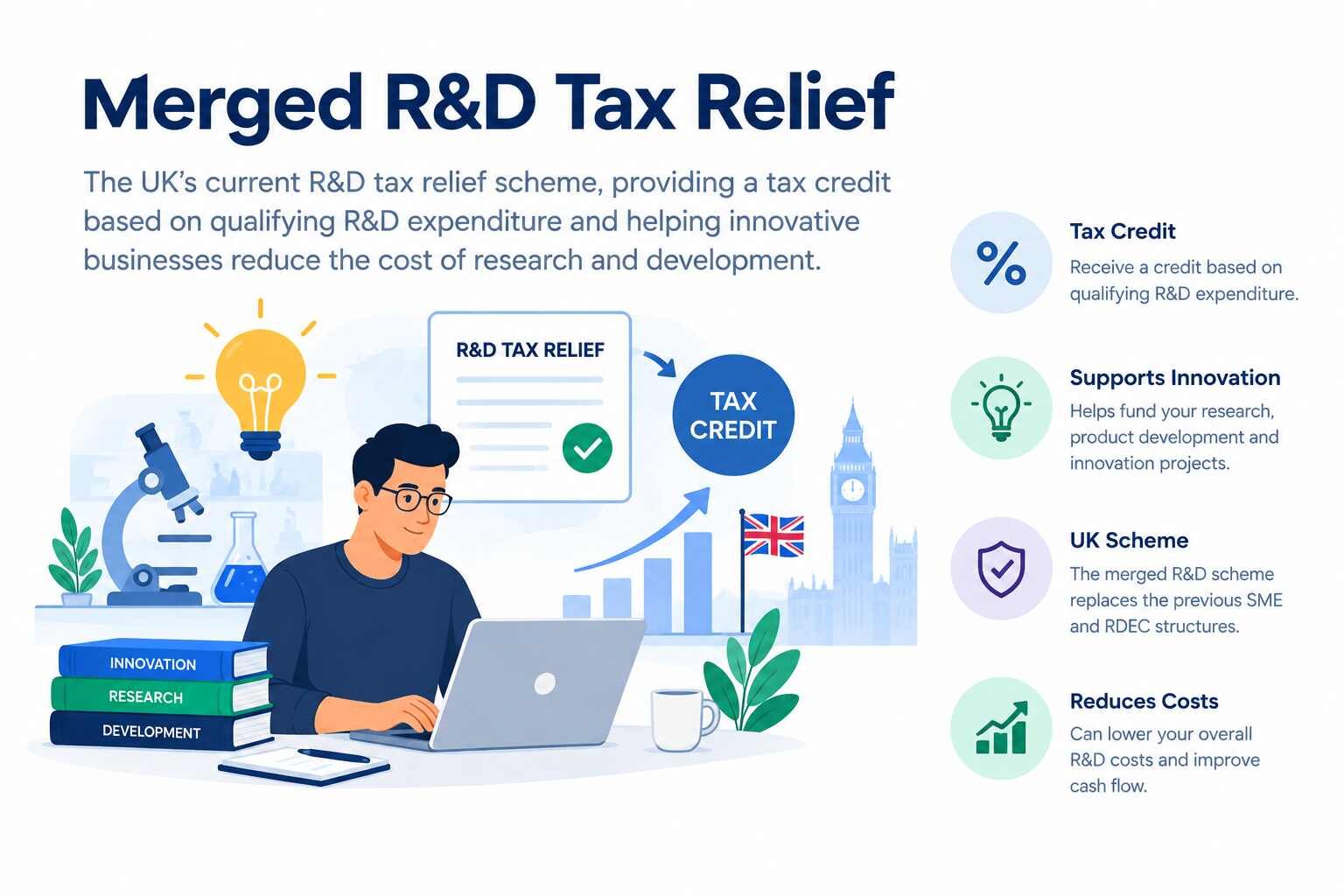
The merged R&D tax relief scheme, formally known as the merged R&D Expenditure Credit scheme, provides tax support to companies carrying out qualifying research and development activities.
The scheme brought together the previous SME and RDEC schemes for accounting periods beginning on or after 1 April 2024.
Under the merged scheme, the headline R&D Expenditure Credit rate is generally 20% of qualifying R&D expenditure.
However, the 20% figure should not be interpreted as a guaranteed cash payment. The credit is taxable and the final benefit depends on the company’s circumstances, qualifying expenditure and the rules applicable to the claim.
This distinction is particularly important for finance leaders preparing forecasts and assessing the potential financial impact of an R&D claim.
When Does the Merged RDEC Scheme Apply?
The merged scheme generally applies to accounting periods beginning on or after 1 April 2024.
Companies with accounting periods covering different periods of the R&D tax regime should take care when determining which rules apply.
This is one reason businesses should avoid relying on older R&D tax relief articles without checking the accounting period to which the information relates.
The UK R&D tax regime has evolved considerably, so the date of the accounting period can be an important part of the assessment.
What Does HMRC Consider to Be R&D?
A company does not qualify simply because it describes a project as innovative or because a product is new to the market.
For tax purposes, the project needs to satisfy the relevant definition of research and development.
Broadly, qualifying R&D involves seeking an advance in overall knowledge or capability in a field of science or technology, or an appreciable improvement to an existing product, process or service through resolving scientific or technological uncertainty.
This can include situations where a business has to overcome genuine technical challenges that cannot readily be resolved using publicly available knowledge or standard professional practice.
For example, a software company may undertake qualifying R&D where its development team must resolve a significant technological uncertainty while creating a new system.
By contrast, routine software development, ordinary product updates or work based entirely on established methods will not necessarily qualify.
The nature of the technical challenge matters more than the marketing description of the project.
Which Businesses May Qualify?
R&D tax relief can potentially apply across a wide range of UK industries.
Examples may include:
- Software and technology businesses
- Engineering companies
- Manufacturing businesses
- Life sciences companies
- Electronics businesses
- Construction and materials businesses
- Product development companies
- Telecommunications businesses
- Businesses developing technically complex processes
The industry itself does not determine eligibility.
Instead, the company needs to consider the specific activities undertaken, the scientific or technological challenges involved and the expenditure associated with qualifying R&D.
This means a company that does not have an R&D department could still potentially undertake qualifying R&D.
What R&D Costs Can Qualify?
Identifying qualifying expenditure is a central part of an R&D tax relief claim.
Depending on the circumstances and applicable rules, qualifying expenditure can include certain costs associated with:
Employee Costs
Staff working directly on qualifying R&D projects may generate eligible expenditure.
Companies should consider the proportion of an employee’s time that relates to qualifying R&D rather than automatically including the entire employment cost.
A robust allocation methodology can help demonstrate how the figures were calculated.
Software Costs
Certain software expenditure used directly for qualifying R&D may be eligible.
The finance team should assess the nature and use of the software and apply any relevant restrictions before including it in the claim.
Subcontracted R&D
Certain subcontracted R&D expenditure may qualify under the rules applicable to the company’s claim.
Businesses should examine the contractual arrangement and the specific nature of the work rather than assuming every external development cost is eligible.
Consumable Materials
Certain materials used or transformed during qualifying R&D activities may also be relevant.
The company should retain appropriate accounting records showing the expenditure and its connection with the R&D activity.
Why R&D Tax Relief Matters to CFOs and Finance Directors
R&D tax relief is not simply a tax return exercise.
For a finance leader, the process can provide an opportunity to examine how much the organisation is investing in research, development and technological improvement.
A properly managed R&D review can help finance teams understand:
- Which projects involve significant technical expenditure
- How employee resources are allocated
- Which development costs may be eligible
- What supporting evidence exists
- Where financial records could be improved
- How innovation expenditure fits into wider business planning
For larger or growing businesses, these considerations can also form part of broader financial governance.
R&D Tax Relief and Cash Flow Planning
One of the most important considerations for senior management is the difference between a potential tax credit and immediate cash flow.
The headline RDEC rate does not mean that a business automatically receives 20% of every pound spent on development.
The calculation involves qualifying expenditure, tax treatment and other applicable rules.
Therefore, businesses should avoid building cash-flow forecasts around an assumed R&D benefit until the claim has been properly assessed.
For CFOs, a more appropriate approach is to treat a potential R&D benefit as an item requiring appropriate review, documentation and financial modelling.
What Evidence Should a Business Keep?
Good documentation is important when preparing an R&D claim.
A company should be able to explain what the project was trying to achieve, what technological challenge existed and how the business attempted to resolve it.
Useful records may include:
- Project documentation
- Technical reports
- Development notes
- Testing records
- Research documentation
- Project plans
- Employee time records
- Invoices
- Payroll information
- Accounting records
- Software development documentation
The precise evidence required will depend on the company’s circumstances.
The objective should be to create a clear connection between the qualifying R&D activity and the expenditure included in the claim.
How Should a Company Start an R&D Tax Relief Review?
A structured review can make the process easier for both finance and technical teams.
Step 1: Identify Development Projects
Start by creating a list of significant development projects undertaken during the relevant accounting period.
Do not restrict the review to projects formally labelled “R&D”.
Step 2: Speak to Technical Teams
Finance teams may not have enough technical information to determine whether a project involved qualifying technological uncertainty.
Speaking with developers, engineers, scientists or other technical specialists can help identify the nature of the work undertaken.
Step 3: Identify Technical Uncertainty
Consider what technical problem the team was attempting to solve.
Ask questions such as:
- What was technically difficult?
- Was the solution readily available?
- Did the team need to experiment?
- Were multiple approaches tested?
- What technical knowledge had to be developed?
Step 4: Reconcile the Costs
Once potentially qualifying projects have been identified, review the associated expenditure against the applicable R&D rules.
Costs should be supported by the company’s accounting records.
Step 5: Check HMRC Requirements
Businesses should check the current HMRC requirements concerning claim notifications, additional information and submission procedures.
These requirements can depend on the company’s circumstances and accounting period.
Step 6: Review Before Submission
The final claim should be reviewed carefully before submission.
Any figures, project descriptions and supporting information should be consistent with the company’s records.
Common R&D Tax Relief Mistakes
Mistake 1: Treating Innovation as Automatically Qualifying
A new product or service is not automatically R&D for tax purposes.
The project must satisfy the relevant scientific or technological criteria.
Mistake 2: Claiming All Development Costs
Not every cost associated with a development project is necessarily eligible.
Costs should be assessed against the relevant legislation and HMRC guidance.
Mistake 3: Using Weak Technical Descriptions
A vague statement such as “we developed new software” may not adequately explain the technical challenge involved.
The claim should clearly describe the relevant technological uncertainty and the work undertaken to address it.
Mistake 4: Ignoring the Accounting Period
R&D tax relief rules have changed.
Using guidance written for an earlier accounting period can lead to incorrect assumptions.
Mistake 5: Treating the R&D Claim as a Finance-Only Exercise
Technical teams often hold important information about the development process.
A collaborative approach between finance and technical staff can produce a more complete understanding of the company’s activities.
Is R&D Tax Relief Only for Technology Companies?
No.
Although technology companies are often associated with R&D tax relief, qualifying R&D can take place across many sectors.
An engineering company developing a new production technique, for example, may encounter technological uncertainty.
Likewise, a manufacturer developing a technically improved production process may need to investigate whether its activities satisfy the R&D definition.
The key question is not whether a company considers itself a technology business.
The important question is whether the specific project satisfies the applicable R&D requirements.
What Should CEOs Consider?
For CEOs, the main consideration is whether the company’s approach to innovation is being reflected accurately in its financial processes.
Senior management should consider:
- Whether potentially qualifying projects are being identified
- Whether development expenditure is properly recorded
- Whether technical evidence is available
- Whether the company has appropriate internal controls
- Whether external support is required
- Whether the potential tax benefit has been treated appropriately in financial planning
R&D tax relief should form part of a wider approach to financial governance rather than being viewed simply as an opportunity to reduce tax.
What Should CFOs Consider?
CFOs can play an important role in ensuring that R&D claims are supported by reliable financial information.
Areas worth reviewing include:
- Payroll records
- Project accounting
- Cost allocation
- Supplier invoices
- Subcontractor arrangements
- Accounting-period treatment
- Supporting technical evidence
- Claim calculations
- Internal approval procedures
A documented process can make it easier to explain how the claim was prepared and how the figures were derived.
Can a Business Use an External R&D Tax Specialist?
Yes, a company may choose to seek assistance from an external specialist.
This can be particularly relevant where the business has complex technical projects, significant R&D expenditure or limited internal experience with R&D tax claims.
Before engaging a provider, management should consider its experience, fee structure, approach to compliance, documentation standards and understanding of the applicable HMRC requirements.
Businesses should also ensure they understand exactly which organisation is providing the service and what role any intermediary or referral partner plays.
Frequently Asked Questions
What is UK merged R&D tax relief?
The merged R&D tax relief scheme is the UK’s R&D Expenditure Credit scheme for qualifying accounting periods beginning on or after 1 April 2024. It provides a tax credit based on qualifying R&D expenditure, subject to the applicable rules.
What is the current merged RDEC rate?
The headline merged RDEC rate is generally 20% of qualifying expenditure. Because the credit is taxable and other rules can affect the calculation, the headline rate should not be treated as the final amount a company will receive.
Can an SME claim under the merged R&D scheme?
Potentially. The relevant scheme depends on the company’s circumstances and accounting period. Eligible R&D-intensive loss-making SMEs may also need to consider the Enhanced R&D Intensive Support rules.
What expenditure can qualify for R&D tax relief?
Potentially qualifying expenditure can include certain employee costs, software costs, subcontracted R&D and consumable materials, subject to the applicable rules.
Does developing software automatically qualify for R&D tax relief?
No. Software development must meet the relevant R&D requirements. Routine development or work using established technology may not qualify.
How does HMRC assess an R&D claim?
HMRC considers the information submitted by the company and whether the activities and expenditure satisfy the relevant R&D rules. Businesses should therefore ensure that their claims are accurate and supported by appropriate evidence.
Do I need an R&D tax specialist?
Not every company necessarily needs external support. The decision depends on the complexity of the projects, the company’s internal expertise and the level of support required.
Can R&D tax relief improve business cash flow?
Potentially, but businesses should not assume that the headline R&D credit rate translates directly into cash received. The actual benefit depends on qualifying expenditure, tax treatment and the company’s circumstances.
Final Takeaway
UK merged R&D tax relief can be an important consideration for businesses investing in research and development.
For CEOs and CFOs, the key is not simply identifying a potential tax benefit. A robust approach involves identifying qualifying projects, understanding the relevant scientific or technological challenges, accurately calculating eligible expenditure and maintaining appropriate supporting evidence.
Because the UK R&D tax regime has changed, businesses should always consider the rules applicable to their specific accounting period.
If your company is investing in software, engineering, manufacturing, technology or other technically challenging development work, reviewing your R&D expenditure may be worthwhile.
Before making a claim, check the latest HMRC guidance and consider obtaining appropriate professional advice where the circumstances are complex.
About Accounting’s Affiliate Disclosure
About Accounting is an independent educational website covering accounting, finance and business topics.
Some articles may contain affiliate links to third-party service providers. If you choose to use a service through one of our affiliate links, About Accounting may receive a commission at no additional cost to you.
Our editorial content is intended to provide general information and does not constitute tax, accounting or legal advice.
Disclaimer
Tax legislation and HMRC requirements can change. The information in this article is provided for general educational purposes and should not be relied upon as professional tax advice. Businesses should verify the rules applicable to their circumstances and accounting period and obtain independent professional advice where appropriate.