Employer of Record vs PEO vs Payroll Provider: What’s the Difference?
Businesses often use the terms Employer of Record (EoR), Professional Employer Organisation (PEO) and payroll provider interchangeably.
However, these models serve different purposes.
Understanding the distinction is important for CEOs, CFOs and HR leaders who are planning international hiring or reviewing their existing employment structure.
What is an Employer of Record?
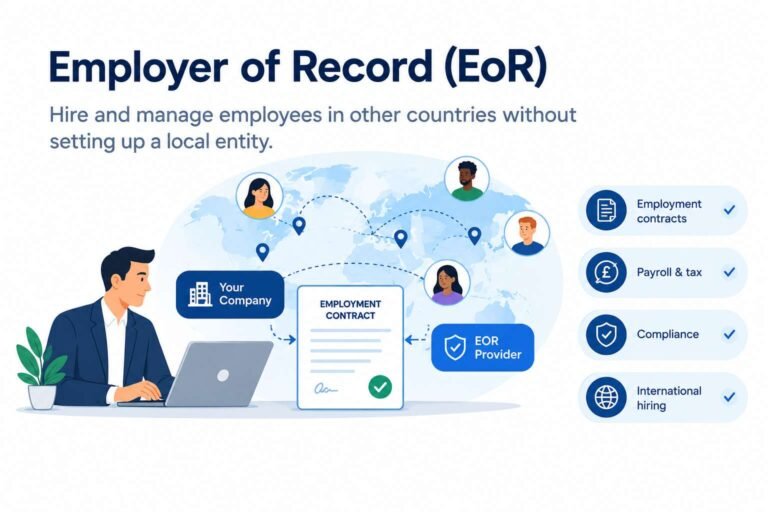
An Employer of Record is a third-party organisation that employs a worker on behalf of a client business in a particular country.
The EoR manages agreed employment administration and the formal employment relationship under the applicable arrangement.
The client normally directs the employee’s daily work and business responsibilities.
An EoR is often considered when a business wants to hire internationally without immediately establishing its own local employing entity.
What is a PEO?
PEO stands for Professional Employer Organisation.
A PEO typically provides HR and employment-related services through a co-employment arrangement, depending on the jurisdiction and service model.
The exact legal structure varies by country.
PEO arrangements should not automatically be treated as identical to EoR arrangements.
What is a payroll provider?
A payroll provider helps process payroll and related administration.
Depending on the service, it may support:
- Salary calculations
- Tax deductions
- Payroll reporting
- Payslips
- Payroll software
- Statutory reporting processes
A payroll provider does not necessarily become the legal employer.
A business must understand whether it already has the required local employing structure before choosing payroll-only services.
EoR vs PEO vs payroll provider
| Feature | EoR | PEO | Payroll provider |
|---|---|---|---|
| Employment model | Provider employs under the arrangement | Co-employment model, where applicable | Does not necessarily employ |
| Payroll | Often included | Often included | Core service |
| HR support | Depends on provider | Often part of service | Depends on package |
| Local entity | May support hiring without client’s own entity | Often requires client entity, depending on jurisdiction | Generally requires employer structure |
| International hiring | Common use case | Depends on jurisdiction | Depends on employer’s existing setup |
The precise legal and commercial model must be confirmed with the provider.
Which option is appropriate for UK hiring?
The answer depends on your current position.
If you do not have a UK employing entity
An EoR may be worth exploring as a way to establish an employment arrangement.
If you already operate a UK company
A payroll provider may be relevant if your main need is payroll processing.
If you require broader HR support
You may need to compare HR outsourcing, payroll and employment administration services.
The best option depends on the actual service requirement.
Questions for CFOs
Before selecting a provider, ask:
- Who is the legal employer?
- Who is responsible for payroll?
- Who handles statutory reporting?
- Is a local entity required?
- What employment risks are covered?
- What services are excluded?
- What are the total costs?
- How can the arrangement be terminated?
These questions can prevent confusion later.
Why the distinction matters
Choosing a payroll provider when your business needs a broader employment structure may leave important responsibilities unresolved.
Likewise, choosing an EoR without assessing your long-term operating plans may create unnecessary costs or structural limitations.
The decision should be based on your business model, not just the name of the service.
Final thoughts
EoR, PEO and payroll providers can serve different business needs.
International companies should identify their actual requirements, understand the legal structure and compare the costs before choosing a solution.
About Accounting provides educational content and affiliate referrals for businesses researching international employment providers.
Affiliate disclosure: Some links may generate a commission for About Accounting.
This article is general information and should not be treated as legal, tax or employment advice.