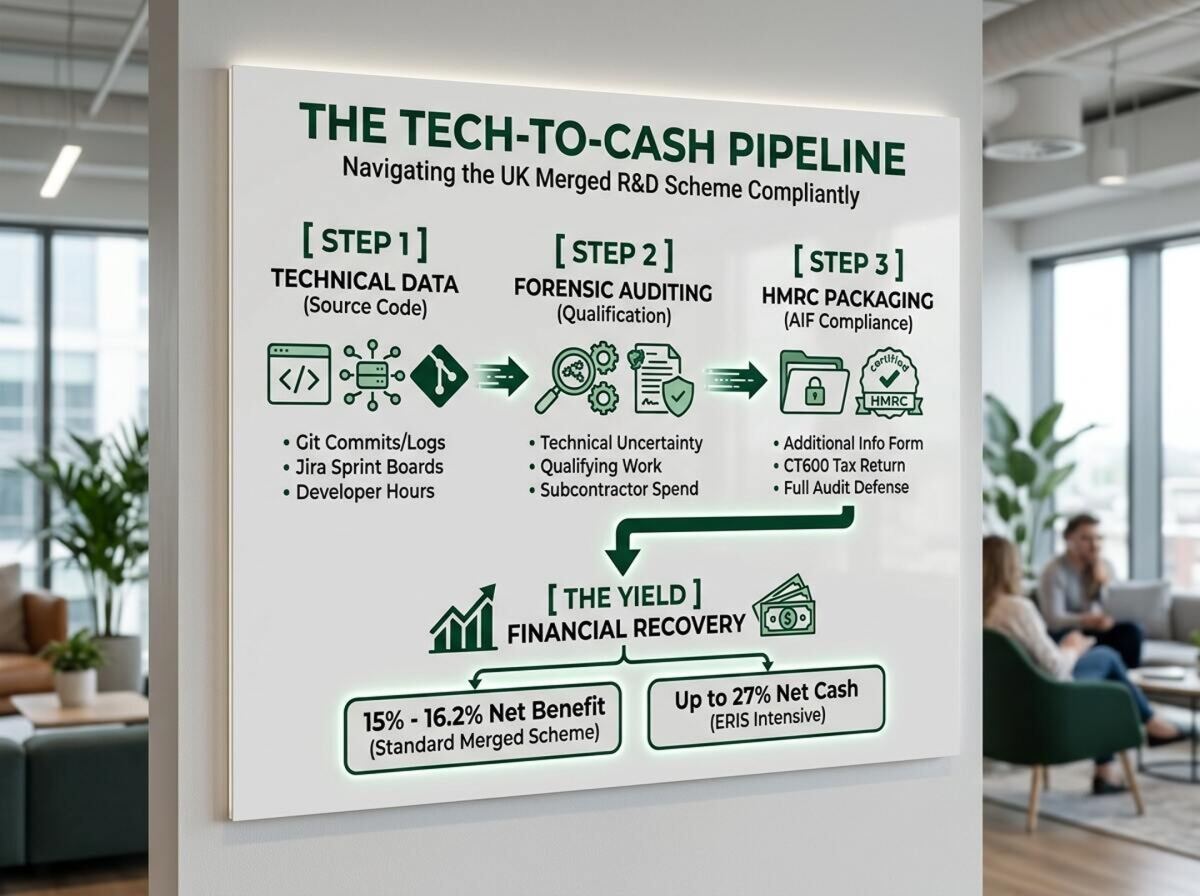

Stop letting administrative bottlenecks derail your innovation funding. We bridge the gap between software development and tax law, packaging your technical engineering data into bulletproof compliance documentation to secure your rightful HMRC tax credits.
The UK research and development tax landscape has undergone its most aggressive transformation in a decade. The consolidation of legacy incentives into the unified UK Merged R&D Scheme means that generic, retrofitted technical narratives no longer survive routine HMRC scrutiny. The introduction of the mandatory Additional Information Form (AIF) requires a level of forensic precision that most high-street accountants simply cannot deliver.
We speak the language of Git commits, architectural technical debts, and agile deployments. We do not just aggregate your payroll numbers at year-end; we continuously analyse your software infrastructure, engineering workflows, and subcontractor agreements to isolate qualifying activities. Whether you qualify for the standard 20% above-the-line credit or the 27% Enhanced R&D Intensive Support (ERIS) framework, we ensure your technical innovations are fully capitalised without triggering compliance vulnerabilities.
Don’t let automated shortcuts put your business at risk. We combine data-driven technical analysis with elite specialist oversight to unlock your maximum eligible HMRC innovation incentives, fully protected against regulatory scrutiny.
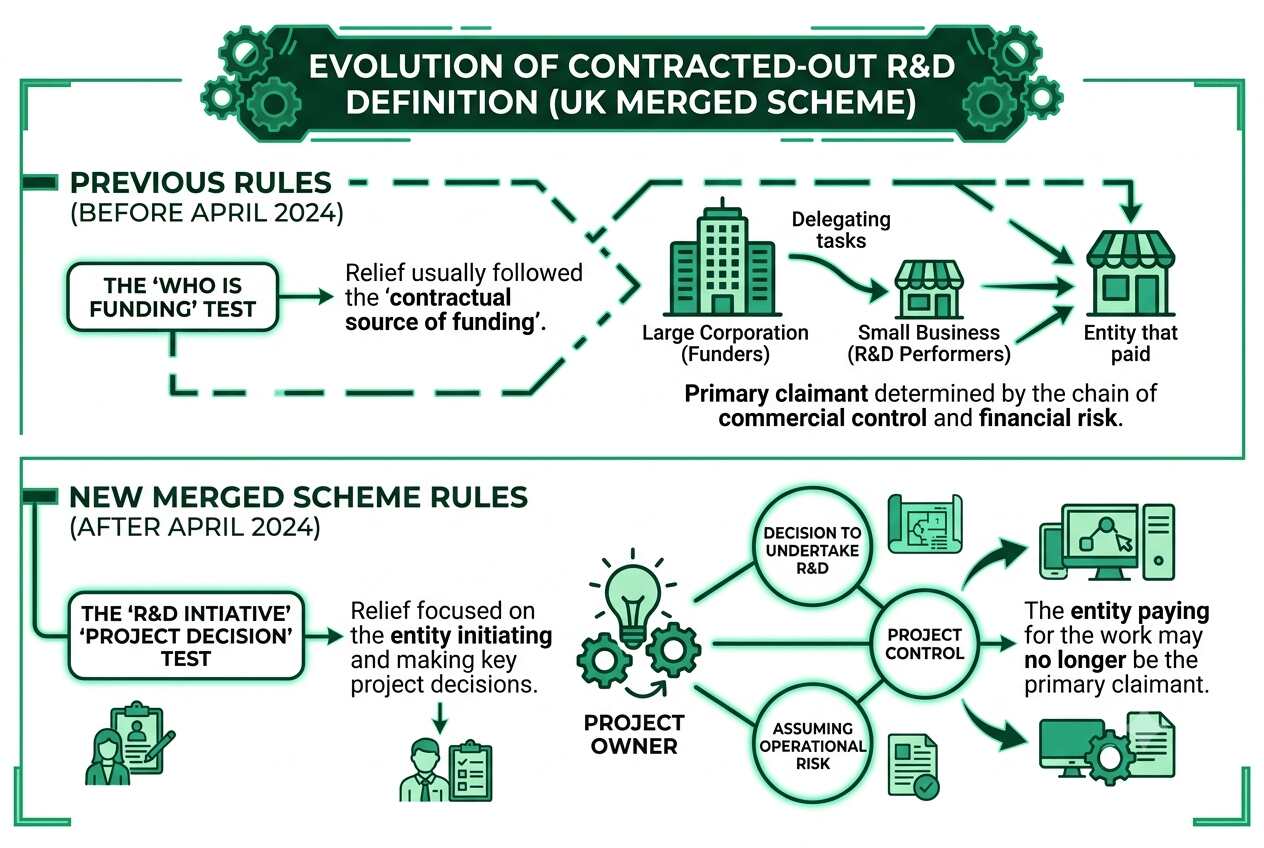
Under the UK Merged R&D Scheme rules, the definition of “contracted-out R&D” has completely changed. If you are paying third-party software developers or external consultants, the entity that actually directs and initiates the R&D holds the legal right to make the claim. We ensure your client contracts are structured to secure these claims first.
HMRC’s recent structural reforms and the mandatory Additional Information Form (AIF) mean that software-only, volume-based claim mills are a major compliance risk. Today, every claim requires an officially registered agent and a thorough, specialist-led technical narrative. aboutaccounting.co.uk operates as your independent compliance gatekeeper—shielding your company from enquiry risks while securing the funding you are legally owed.
Don’t let automated shortcuts put your business at risk. We combine data-driven technical analysis with elite specialist oversight to unlock your maximum eligible HMRC innovation incentives, fully protected against regulatory scrutiny.
We do not ask your engineering leads to draft dry compliance narratives. Our technical specialists extract evidence directly from your source logs, deployment pipelines, and project ticketing systems. We systematically isolate the core technological uncertainties your team resolved, crafting airtight technical documentation that demonstrates clear eligibility before submission..
Modern HMRC guidelines enforce strict geographic limitations on subcontracted R&D and Externally Provided Workers (EPWs). We meticulously audit your commercial agreements to ensure overseas resource expenditure satisfies limited statutory exceptions, and correctly structure UK-based developer contracts to capture the maximum allowable 65% qualifying cost relief.
Failing to correctly submit the mandatory Additional Information Form (AIF) before your Corporation Tax return results in immediate claim invalidation. We manage this end-to-end framework, assigning a named, regulated corporate officer to guarantee total data integrity across all qualifying cost categories, from software licenses to compute infrastructure.
| Compliance & Financial Metrics | Standard UK Merged R&D Scheme | Enhanced R&D Intensive Support (ERIS) |
| Primary Target Audience | Profit-making and non-intensive tech companies | Loss-making, R&D-heavy startups |
| Gross Credit Mechanism | 20% Above-the-line expenditure credit | 86% Enhanced Deduction + 14.5% Cash Credit |
| Intensity Threshold Requirement | None | Minimum 30% of total company expenditure |
| Net Cash Value (Profitable Main Rate) | 15.0% Net Benefit (£15k per £100k spend) | Not applicable (Requires tax loss profile) |
| Net Cash Value (Small Profits Rate) | 16.2% Net Benefit (£16.2k per £100k spend) | Not applicable (Requires tax loss profile) |
| Net Cash Value (Loss-Making Entities) | 15.0% Net Benefit | Up to 26.9% Net Benefit (£27k per £100k spend) |
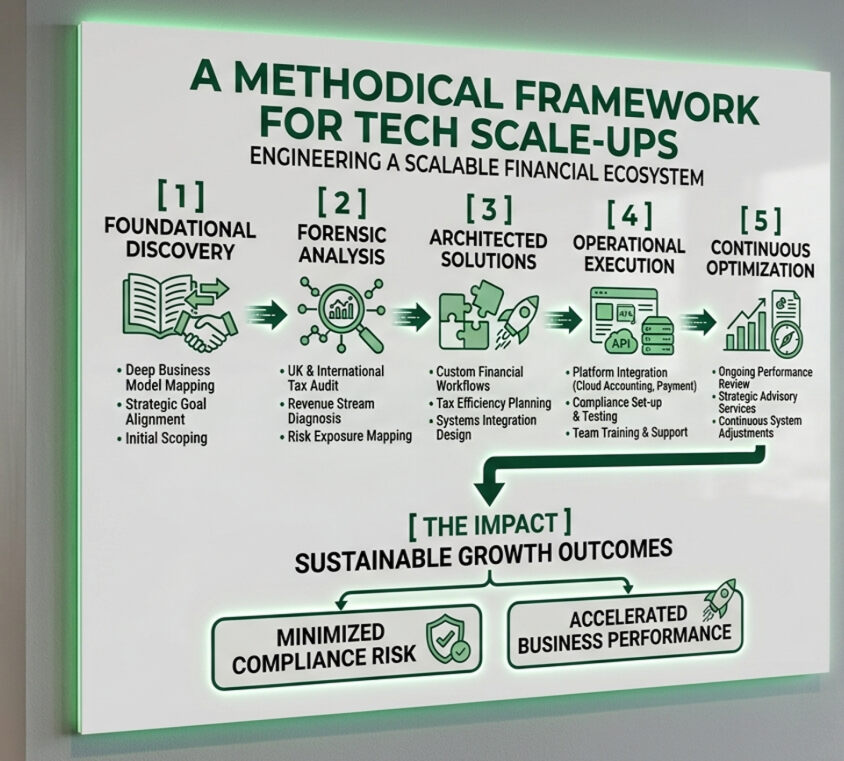
We combine data precision with elite tax expertise to maximize your UK tax relief. First, we audit, extract, and clean your operational logs and qualifying payroll records into a fully verified dataset. Then, our vetted network of HMRC-registered, AML-regulated tax specialists partners provides the formal technical assessment, signs off as the filing agent on your Additional Information Form (AIF), and delivers robust inquiry defense.
We seamlessly audit and extract your operational data, technical project logs, and qualifying staff payroll records. We clean up the data silos to ensure your internal expenditure is perfectly formatted and fully verified before any tax advice is given.
Once your technical data is structured, we route it directly through our vetted network of HMRC-registered, AML-regulated corporate tax specialists. They provide the formal technical assessments, sign off as the filing agent on the AIF form, and back your claim with comprehensive inquiry defense.
Ambitious UK enterprises scale fastest when operational efficiency meets rock-solid regulatory safety. Whether you want to recover vital capital through compliant R&D Tax Relief, scale global teams safely, or eliminate costly workflow inefficiencies, we design the clear financial controls your business needs to move forward with total peace of mind.
Under the unified Merged R&D Scheme rules, the right to claim resides with the company that initially directs, initiates, and bears the financial risk of the R&D project. If a client hires your software agency to build a custom application, and the client specifies the technological challenge, the client typically retains the right to claim. However, if your company initiates independent R&D of its own volition to execute a commercial project, the right remains with your Limited Company. We systematically review your master services agreements to protect these critical intellectual property assets.
Compute costs, storage capacities, and software licensing fees qualify as valid expenditure provided they are directly utilized within an eligible R&D project to resolve a defined technological uncertainty. This includes cloud server allocations (such as AWS or Google Cloud instances) specifically provisioned for running intensive software tests, automated simulations, or staging code deployments. General hosting infrastructure used for day-to-day commercial production environments must be excluded.
To claim under the more generous Enhanced R&D Intensive Support (ERIS) scheme, a loss-making SME must maintain a minimum R&D intensity ratio of 30% relative to total corporate spend. If your business undergoes an exceptional operational shock or experiences a temporary contraction in development spend that drops your intensity ratio below 30%, a statutory one-year grace period applies. This allows your Limited Company to maintain your ERIS status for that specific period, provided you successfully met the intensity condition and lodged a valid claim in the immediately preceding year.
Yes, in specific circumstances. If your Limited Company is a first-time claimant, or if you have not submitted an R&D claim in any of the three preceding financial years, you must lodge a digital Claim Notification Form with HMRC. This notification must be submitted within six months from the end of the accounting period to which the claim relates. Failure to lodge this advance notice within the strict six-month window completely invalidates your right to submit an R&D claim for that financial year, regardless of how much eligible software engineering occurred.
No. Under statutory HMRC guidelines, dividends are classified as a distribution of corporate profit rather than a direct operational expenditure. To qualify for R&D staff cost relief, the remuneration must be subject to Class 1 National Insurance Contributions (NICs) via a standard Pay As You Earn (PAYE) payroll structure. Tech founders who draw a minimal baseline salary and extract the remainder of their income via dividends will see their qualifying director expenditure heavily restricted to just the fractional percentage of the PAYE salary dedicated to technical uncertainty resolution.
Routine software deployment, customising open-source plugins, building standard e-commerce architectures, or using established APIs do not qualify as R&D. To satisfy HMRC’s definition, your technical team must be seeking an advance in overall science or technology by overcoming an algorithmic or structural challenge that is not readily deducible by a competent professional in the field. Examples include engineering proprietary data compression protocols, resolving multi-tenant database latency at extreme scale, or integrating disparate legacy systems where no public integration framework exists.
Under the legacy SME rules, receiving a notified State Aid grant (such as an Innovate UK grant) could entirely disqualify a project from the highly lucrative SME tax credit route. Under the unified Merged R&D Scheme rules, this restriction has been fundamentally modernised. Subsidised or grant-funded expenditure is no longer automatically excluded from relief. However, complex rules dictate whether the grant provider or the recipient holds the legal right to claim the credit. We review the exact wording of your grant funding agreements to ensure your development spend is structured correctly to avoid double-claiming issues.
A UK Limited Company has exactly two years from the final day of the relevant accounting period to amend its Corporation Tax return (CT600) and lodge an R&D claim with HMRC. For example, if your company’s financial year ended on 31 December 2024, you must fully execute your Additional Information Form (AIF) and submit the final tax return amendment before midnight on 31 December 2026. HMRC has no statutory authority to grant extensions for missed filing deadlines, making proactive data collection essential.
Do not expose your enterprise to unexpected tax penalties. Let us run a strict, confidential assessment of your technical projects and connect you with the UK’s leading regulated corporate tax frameworks.
We use cookies to personalize content and analyze our traffic. We don't share or sale any kinds of information about your use of our site with anyone. You can change your preferences at any time. For more information, please see our Privacy Policy and Cookie Policy. Privacy Policy Cookie Policy
